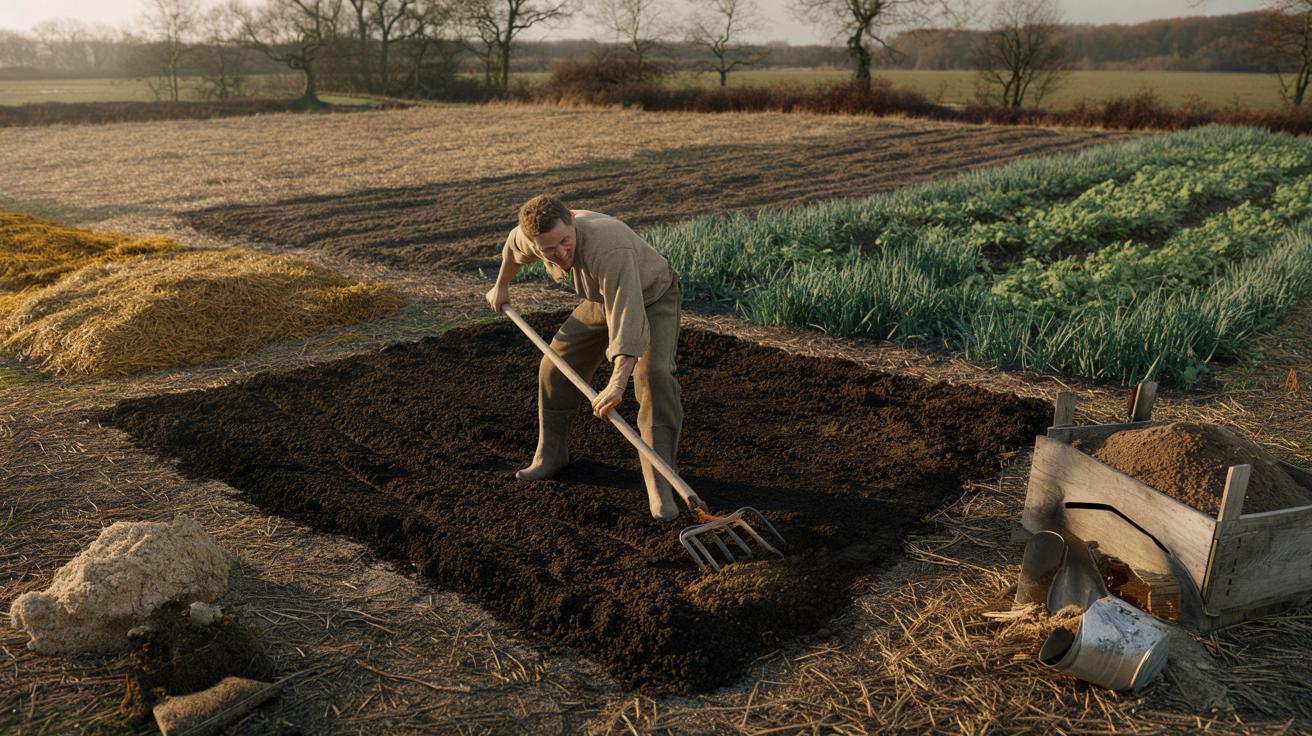
They are not rushing to sow seeds or plant tomatoes. They are doing something older, slower and, according to many, far more decisive for the size of their harvests: preparing the soil in a very specific way, right in February.
Why February became the farmers’ secret weapon
Traditional growers watched the seasons closely, long before weather apps and seed catalogues. February was their signal month. The soil had begun to warm, yet weeds had not exploded into life. For them, this was a narrow but powerful window.
- The ground is still in partial dormancy, so perennial weeds are easier to manage.
- The soil retains winter moisture, which helps organic matter break down.
- Temperatures start to climb, waking up microbes that turn waste into plant food.
February sits at the crossroads: the soil is no longer frozen, not yet invaded by weeds, and perfectly placed to be reshaped for the year ahead.
Older farmers understood something many new gardeners overlook: the way you treat the soil in late winter can decide the strength, speed and resilience of your crops months later.
The five-stage method that quietly doubled yields
1. Reading the soil before touching it
Veteran growers never grabbed a shovel first. They started by looking and feeling. Is the earth clumping in heavy, wet slabs? Does it crumble between the fingers? Is it pale and chalky or dark and rich?
- If the soil sticks to boots and tools, it is too wet and working it will compact it.
- If it is powdery and very dry, a light surface cultivation wakes up life without destroying structure.
- A simple pH test, still sold today in garden centres, reveals whether the soil leans acidic or alkaline.
This first step shaped everything that followed. Rather than using a fixed recipe, they adapted amendments and cultivation depth to what the soil actually needed.
2. Loosening, not flipping, the earth
Historic ploughing often went deep, but many small-scale growers and market gardeners, especially in vegetable plots, used a gentler approach. Today, tools like the broadfork echo that thinking.
Instead of inverting the layers and burying the living topsoil, they slipped in long tines and rocked them back, cracking the ground open without turning it over.
- This technique increased oxygen in the root zone while leaving soil life roughly where it liked to live.
- Water could drain more freely instead of pooling on the surface.
- Seedlings later pushed their roots into loosened channels with much less effort.
The goal was not to battle the soil but to ease it open, keeping its delicate underground architecture intact.
➡️ 5 psychologische Anzeichen, um eine schädliche Person schnell zu erkennen
➡️ 4 Olivenöle, die man besser nicht kauft: 60 Millions de consommateurs schlägt Alarm
➡️ Wie du eine verbrannte Pfanne mit einer Chef‑Methode auf Salzbasis rettest
3. Feeding the soil with slow, rich materials
Once the structure was gently opened, the ancients focused on food. Not for the plants directly, but for the soil itself. February’s cool, moist conditions gave bacteria, fungi and worms the perfect setting to start breaking down organic matter.
- Mature compost was spread in a thin layer, adding humus that improved both fertility and water balance.
- Well-rotted manure went onto areas destined for heavy feeders such as squash, tomatoes or aubergines.
- Naturally derived amendments like wood ash added potassium, helping future flowers and fruits develop more strongly.
They did not expect instant results. These inputs were laid down weeks before planting. Microbes had time to transform them, tuning the soil like a slow-release pantry rather than dumping a quick fertiliser.
4. Using living plants as winter helpers
Leaving soil bare was seen as wasteful. Rain washed nutrients away, wind stripped fine particles, and sun later baked the surface. Many older systems kept something growing almost year-round.
- Green manures such as clovers, vetch or field beans were sown on vacant beds.
- These plants fixed nitrogen from the air or captured leftover nutrients in their roots and leaves.
- As spring approached, they were cut and left on the surface or gently mixed into the top layer.
Living roots acted as a bridge between seasons, catching fertility that would otherwise have vanished and recycling it straight back into the soil.
Even when sown late, hardy species tolerated frosts and still offered benefits: better structure, richer organic matter and fewer winter weeds.
5. Shielding and gently warming the ground
Ancient growers might not have talked about “microclimates”, but they understood that a protected soil behaved very differently from a bare one. Where they had materials, they covered the ground.
- Layers of straw, dead leaves or shredded branches formed a loose blanket.
- This cover reduced erosion, slowed temperature swings and sheltered earthworms.
- Dark covers or simple tarps on specific beds helped the soil warm faster before early sowings.
By late spring, these protected beds often dried out less quickly, crusted less and produced more vigorous seedlings. The difference could be stark even inside the same garden.
Mistakes that quietly destroy all that work
Alongside their February routine, experienced growers also avoided a few habits that modern gardeners still fall into.
- Working ground when it is soaked, which compresses pores and leaves roots struggling for air.
- Turning soil deeply, which buries surface organisms and brings less active layers to the top.
- Skipping organic inputs, leading to tired soil that cannot support heavy cropping.
- Leaving earth exposed to wind and rain, which strips away both structure and nutrients.
Every spadeful either builds a living system or breaks it; February is when those choices echo longest through the year.
How this February method plays out in a real garden
Picture a small vegetable patch divided into a few beds. One bed is prepared with this traditional February routine, another is left untouched until April. The difference by midsummer is rarely subtle.
| Practice | Traditional February bed | Untouched spring bed |
|---|---|---|
| Soil structure | Crumbly, easy to plant | Cloddy or compacted |
| Weed pressure | Lower, thanks to cover and early action | Higher, weeds germinate with crops |
| Plant growth | Faster start, deeper roots | Slower, stressed in dry or wet spells |
| Harvest size | Heavier, with more uniform produce | Smaller, with more failures |
Farmers who persisted with the February routine often reported beds yielding nearly twice as much, or producing the same quantity with fewer inputs and less watering.
Key terms gardeners still ask about
Several traditional ideas have resurfaced in modern gardening discussions, sometimes with new jargon. A few are worth clarifying.
- Green manure: temporary crops grown purely to feed and protect the soil, not to eat.
- Broadfork or grelinette: a wide, two-handled tool with metal tines, designed to loosen soil without flipping it.
- Humus: the dark, stable fraction of decomposed organic matter that holds water and nutrients like a sponge.
Understanding these terms helps gardeners translate old habits into modern practice without getting lost in marketing slogans or gadget-driven trends.
Practical ways to adapt the old method to a tiny space
Not everyone has a field or even a large garden. This February approach scales surprisingly well to balconies and small yards.
- In raised beds, use a hand fork instead of a broadfork, loosening the top 15–20 cm.
- On balconies, refresh containers by mixing in compost and a little sieved, rotted manure, then adding a light mulch.
- For paved yards, create shallow soil beds in boxes or sacks, still following the same sequence: loosen, feed, cover.
The principle is the same whether you manage two square metres or two acres: prepare early, disturb gently, feed generously with organic matter and keep the soil covered.
The old February routine was less about tradition for its own sake and more about timing, observation and respect for the living soil underfoot.
For gardeners in temperate climates, revisiting that approach now can mean sturdier plants, fewer chemical inputs and, as many elders quietly claimed, harvests that feel suspiciously like they have been doubled.