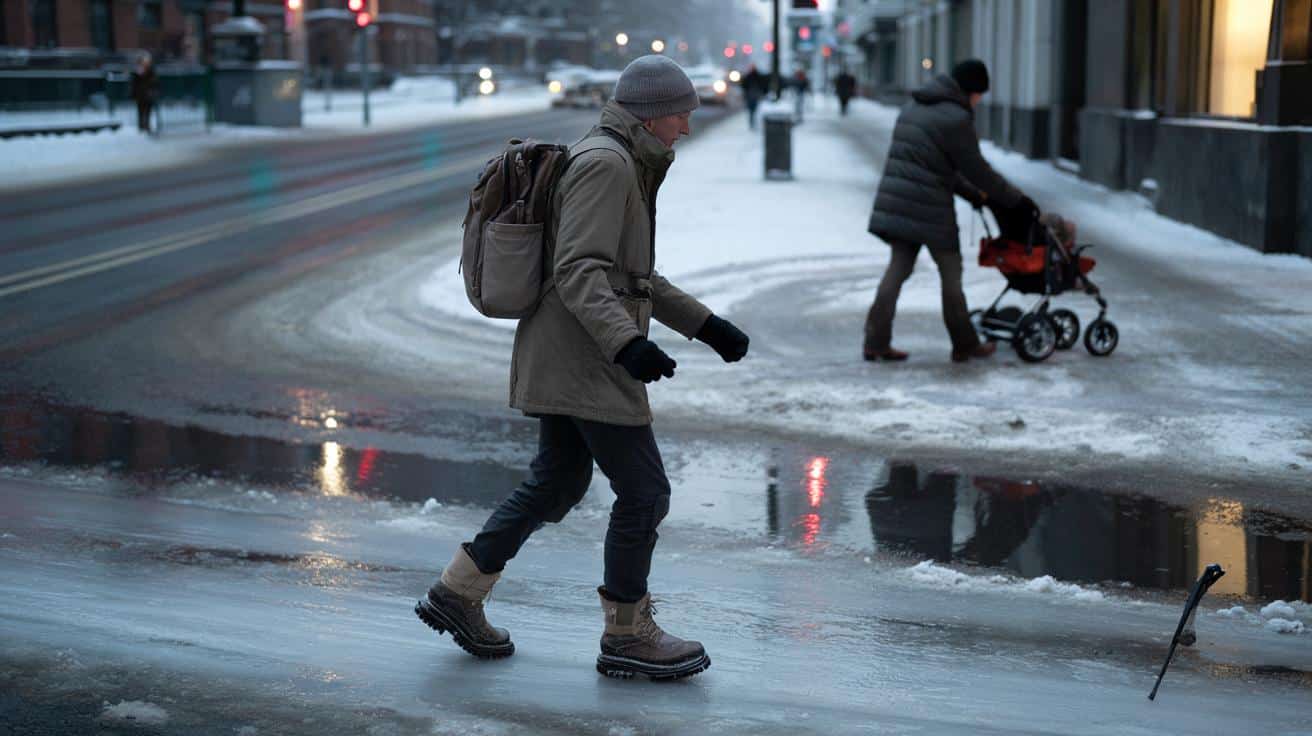
Across Europe and North America, emergency departments see a spike in broken wrists, hips and heads every time temperatures dip below freezing. Most of those injuries start the same way: a normal walk to work, the school run, or a quick dash to the shops that ends with a slip on invisible ice. The good news is that a few simple habits cut that risk dramatically.
Why winter pavements are so treacherous
Black ice forms when melted snow or rain refreezes into a thin, transparent sheet. It’s hard to see, especially at dawn or after dark. Packed snow can be just as risky once thousands of feet compress it into a smooth, polished layer.
Falls on ice are one of the leading causes of winter injuries in older adults, but younger people are far from immune.
Speed, overconfidence and poor footwear all play a role. Commuters rushing for trains, parents pulling buggies, cyclists dismounting at junctions – everyone is exposed. These nine tactics, inspired by safety advice from cold-climate countries, help you stay upright when the ground turns slick.
1. Choose footwear that actually grips
Fashion trainers or smooth-soled boots behave almost like skates on ice. What you need instead is texture and support. Look for:
- Deep rubber lugs on the sole for grip
- A high ankle or boot that supports the joint
- Waterproof material to keep feet dry and warm
Hiking boots, winter walking boots or insulated work boots usually tick those boxes. If you can’t justify a dedicated pair, buy slip-on ice grips that stretch over your usual shoes and add metal studs under the sole.
Your footwear is your first line of defence; smooth soles dramatically increase your braking distance on ice.
One quirky but effective trick used in snowy regions: pull thick sports socks over your shoes when conditions are extreme. The fabric adds friction on compacted snow. They will be ruined by the end of the day, but they can save you from a nasty fall on the most treacherous stretches.
2. Aim for fresh snow, not polished paths
If pavements are covered, try to walk on fresh, undisturbed snow rather than on shiny, trodden sections. New snow still has structure and texture. It compresses underfoot and offers a bit of grip. The smooth grey or glassy patches nearby often hide solid ice underneath.
➡️ This simple winter habit promises hydrangeas smothered in blooms this spring
➡️ Only 7 cm… and yet most gardeners still refuse to admit it
➡️ The ancients always prepared their soil this way in February: their harvests were twice as abundant
➡️ Help Birds Survive The Coldest Nights: The One Food That Brings Their Warmth Back
Be alert when the route forces you onto darker, compressed tracks or slushy piles at road crossings. Those are the spots where water refreezes overnight and injuries cluster the next morning.
3. Use the “penguin walk” on icy stretches
There is a reason safety campaigns in Nordic countries talk about “walking like a penguin”. It looks odd, but it works. On clearly icy ground:
- Take short, quick steps instead of long strides
- Keep your feet flat and slightly turned out
- Lean your upper body a little forwards, over your front foot
- Let your arms hang loose and wide for balance
The more your weight sits directly over your front foot, the less likely you are to slip backwards.
Children often find this hilarious, which helps. Turning it into a game on the school run keeps them focused instead of running or jumping on icy pavements.
4. Swap handbags and briefcases for a backpack
One-sided loads drag your body off-centre. A heavy tote, laptop bag or shopping bag can pull you just far enough to one side that a small slip turns into a full fall. A backpack keeps the load close to your spine and distributes weight more evenly.
With both hands free you can hold railings, steady yourself on walls or break a stumble before it turns into a crash. Tighten the shoulder straps so the pack does not swing when you change direction.
5. Slow your pace and scan the ground ahead
Most people walk at the same speed year-round, then feel shocked when they end up on the ground. Icy days call for a different mindset. Think of yourself as moving through a building site rather than down a familiar street.
Cut your normal walking speed in half and test each step before putting full weight on it.
Keep your gaze ahead rather than down at your feet. Looking three to four metres in front of you helps your body prepare for changes in surface. Avoid sudden twists of the head or torso, which shift your centre of gravity abruptly.
6. Free your hands, warm them with gloves
Shoving your hands in your pockets feels comforting in the cold, but it removes your natural stabilisers. You lose the ability to counterbalance with your arms or grab a rail or a wall when you slip.
Wear proper gloves or mittens instead, and commit to keeping your hands out and ready. On very icy days, resist walking while texting, holding hot drinks or juggling shopping bags. Anything that ties up your hands increases your risk.
7. Pick the safer side of the street
Not all pavements in the same road carry the same risk. One side may catch the morning sun and stay relatively dry; the other may sit in permanent shade and hold ice for days.
| Surface | Typical risk level |
|---|---|
| Sunny pavement, salted | Low to moderate |
| Shaded pavement, unsalted | High |
| Steps and ramps | Very high |
| Car park entrances and driveways | High |
If you have a choice, walk on the side where snow has melted and dried. In narrow alleys or between buildings, stay on fresh snow rather than on shiny patches. Treat outside steps as high-risk: metal or stone stairs often hide nearly invisible ice on every edge.
8. Use walking poles or sticks for support
In very icy towns and villages, walking poles are no longer just for weekend hikers. Lightweight trekking poles, or even simple walking sticks with rubber or metal tips, add a third and fourth point of contact with the ground.
Adjust the poles so your elbow forms roughly a right angle when the tip rests on the pavement. Plant them slightly ahead and to the side of each step. If one foot slips, the pole often catches you before you accelerate into a hard fall.
9. Learn how to fall with less damage
No technique removes risk entirely. When you do slip, the way you land can make the difference between bruises and a broken bone.
Trying to stop a fall with stiff, straight arms is one of the fastest routes to a wrist fracture.
Safety instructors teaching winter sports often suggest two key reflexes:
- If you pitch forwards, bend your elbows, try to land on your forearms and roll slightly to spread the impact along your side.
- If you slide backwards, let your bottom take the hit instead of reaching behind you with your hands, which strains wrists and shoulders.
Practising gentle rolls on a soft surface at home can help your body react more smoothly outdoors. The aim is not to become a stunt performer, just to avoid rigid, panic-driven movements.
Hidden risk factors that make falls more likely
Two people can walk the same icy route with very different outcomes. Age, balance, muscle strength and vision all influence risk. Certain medications, including some sleeping tablets and blood pressure drugs, can also affect reaction times or blood pressure when you stand up.
For older adults, a simple “stand on one leg” test offers a rough check. If you struggle to stay on one foot for more than a few seconds while holding onto a chair for safety, winter balance training may help. Gentle exercises like tai chi, heel-to-toe walking along a hallway, or repeatedly standing up from a chair without using your hands strengthen the muscles you need outside.
Practical scenarios: from front door to bus stop
Imagine an early Monday commute after a night of freezing rain. The front step is glassy, the pavement ungritted, and cars crawl past on slushy roads. In that situation, a few practical choices matter:
- Use the door frame or rail to test the first step and hold on with one hand.
- Step down sideways rather than straight forwards so you can lean into the support.
- Walk on the snow at the edge of the pavement rather than the shiny central strip.
- Give yourself extra time so you are not tempted to run for the bus.
Parents heading out with prams or pushchairs face added challenges. Heavy buggies are hard to control on slopes, and straps can tangle if you fall. In severe conditions, a baby carrier worn close to the chest may offer better stability than a pushchair on ice, provided you use footwear with good grip.
Why small habits add up over the winter
Many people treat each icy day as an isolated event, yet the risk accumulates over a whole season. A minor slip that seems trivial in your thirties can set off months of pain or loss of confidence later in life.
Combining several of these habits has a multiplying effect. Good boots plus slower walking, free hands and careful route choices together cut risk far more than any one measure alone. On days when the forecast mentions black ice, think of these tactics less as extra fuss and more as part of a cold-weather routine, like grabbing a coat before you step outside.