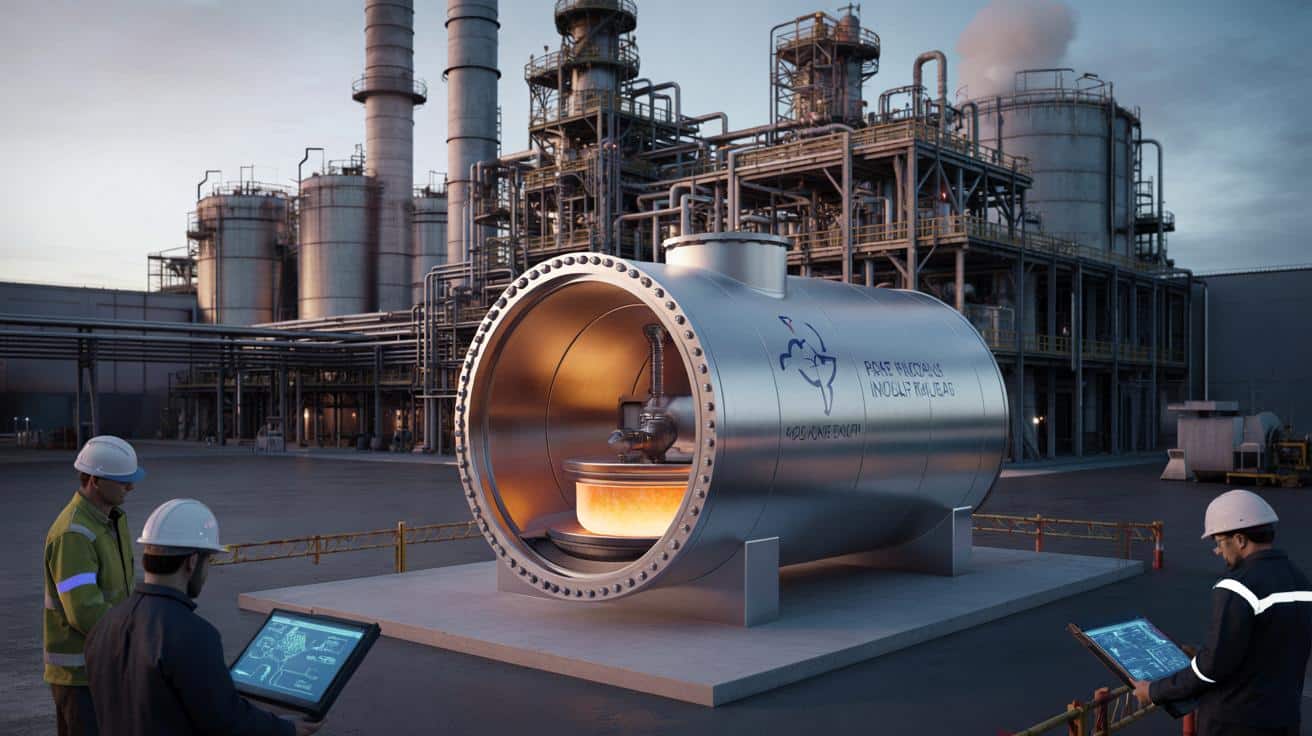
Instead of building another massive plant on the coastline, a start-up spun out of France’s atomic research agency wants to park compact nuclear boilers right next to factories that still burn gas and coal. If regulators agree, that shift could redraw both France’s nuclear map and Europe’s industrial decarbonisation plans.
From giant plants to compact industrial boilers
The company, Stellaria, was created in 2022 from the French Atomic Energy Commission (CEA) and operates out of the Saclay research centre, south of Paris. Its staff is small but highly specialised: reactor physicists, fuel-cycle experts and engineers who spent years inside public research labs.
Instead of chasing the national grid with gigawatt-scale reactors such as the EPR, Stellaria is targeting a very different customer: heavy industry. Cement, glass, chemicals, refining and metallurgy all use large, steady amounts of heat and still rely heavily on fossil fuels.
Stellaria’s core idea: use a mini nuclear reactor as a clean, always-on industrial boiler rather than as a giant power station.
The company argues that if factories can tap into reliable, low‑carbon heat directly on site, they avoid both volatile gas prices and the complexity of rewiring entire electricity networks.
France’s second licence request for a mini-reactor
On 22 January, Stellaria filed a “demande d’autorisation de création” (DAC) with the French Nuclear Safety Authority (ASN) for its prototype reactor, named Stellarium. This is one of the most demanding regulatory steps in the French nuclear system and effectively marks an applicant’s entry into the club of potential operators.
Stellaria is only the second company to do this for a small reactor in France. The first was Jimmy Energy, which submitted a DAC for its own heat‑focused mini‑reactor in early 2024. The two filings show that France’s long‑promised small modular reactor (SMR) ecosystem is finally moving from design slides to formal paperwork.
Two DACs in two years signal that France’s SMR race is no longer theoretical – it is now sitting on the regulator’s desk.
For a start-up, preparing such a file is a major leap. It must set out in detail how the reactor will contain radioactivity, handle accidents, operate safely over decades and eventually be dismantled. That level of scrutiny has traditionally been reserved for state utilities and large engineering groups.
➡️ Experten warnen: Das bedeuten diese Löcher in Ihrem Garten – und warum Sie wachsam bleiben sollten
➡️ Das mache ich seit Jahren: Meine Fenster bleiben streifenfrei dank dieser Küchenzutat
➡️ He decides when we get up“: can a cat really „rule“ a household?
➡️ Help Birds Survive The Coldest Nights: The One Food That Brings Their Warmth Back
➡️ Thermostat mistakes to avoid this winter: how to optimise it for real savings
Stellarium: a molten salt reactor that breaks with convention
The proposed Stellarium unit is not a scaled‑down version of France’s current pressurised-water reactors. It uses a so‑called Generation IV concept: a fast neutron reactor with molten salt technology, where the nuclear fuel is dissolved in a liquid salt that also acts as coolant.
In conventional reactors, solid fuel rods sit in high-pressure water. That water must be kept under tight mechanical control, and a severe loss of cooling can damage core materials. In Stellarium’s concept, the core is already liquid, and the salt operates at near-atmospheric pressure.
- Heat spreads more evenly throughout the liquid mixture.
- The system runs without large, highly pressurised water circuits.
- The classic “core melt” accident loses much of its meaning, as the fuel is already molten.
The molten salts chosen are chemically stable and non-flammable, limiting risks of steam explosions or hydrogen build-up during abnormal events. For advocates, this offers a way to cut the complexity of today’s huge containment buildings.
Safety driven by physics, not just electronics
Stellaria highlights the intrinsic, or “passive”, safety mechanisms of its design. The reactor is meant to respond to temperature changes on its own, without relying solely on pumps, valves or external power.
If the liquid fuel-salt mixture heats up too much, its nuclear behaviour shifts in a way that automatically reduces the rate of fission. In simple terms, the reactor tends to calm itself down as it overheats. Designs of this family also frequently include a freeze plug – a section of salt kept solid by a cooling device. If power is lost and the salt warms, the plug melts and lets the fuel drain into tanks where it cannot maintain a chain reaction.
The start-up wants a reactor that naturally shuts itself down when conditions drift, instead of depending on dense layers of emergency electronics.
For French regulators, such claims will need to be backed by rigorous experiments, modelling and, eventually, real‑world operation. That is where Stellaria’s CEA heritage and access to experimental platforms may prove decisive.
Forty megawatts of heat: exactly what factories use
Stellarium is designed to deliver around 40 megawatts of thermal power. On a national grid, that is modest. In an industrial yard, it is precisely the scale of a large gas or fuel‑oil boiler that many plants run today.
This output can feed processes such as steam networks, high-temperature furnaces or low‑carbon hydrogen production. The footprint is relatively compact compared with a full nuclear power plant. Several modules could be grouped on one site if needed.
- Typical large boiler in a refinery: tens of MW of heat.
- Stellarium design point: ~40 MW thermal.
- Potential use: direct process heat, steam, or power‑and‑heat hybrids.
Modularity also opens the way for factory-style manufacturing. Major components could be built and tested in controlled conditions, then shipped and assembled on site. That contrasts with the one‑off mega‑projects that have plagued Europe’s recent nuclear builds with delays and cost overruns.
A demonstrator targeted for around 2030
Stellaria’s roadmap aims for an operational demonstrator around 2030, assuming the licensing process advances as planned and financing follows. The first unit would not be a commercial fleet reactor but a full‑scale prototype that proves performance and safety in real operation.
Such a demonstrator will matter far beyond France. Governments and industrial clients worldwide have grown wary of nuclear promises that never reach concrete. A working unit, even at modest scale, gives investors something tangible to assess – real availability figures, operating costs, maintenance demands and local acceptance.
In nuclear technology, one running machine often counts more than a thousand PowerPoint slides.
By moving early in the regulatory queue, Stellaria also hopes to influence European norms for small reactors. Shared rules at EU level could shape export prospects and help define what “standard” safety and design features should look like for this new class of plant.
France joins a global race on small modular reactors
Stellarium arrives in a crowded field. From North America to China, companies and state-backed groups are pushing SMR and “advanced modular reactor” concepts aimed at electricity, hydrogen, district heating or industrial processes.
The table below gives a snapshot of several notable projects, including Stellaria’s own design.
| Project | Country | Technology | Typical power | Main use | Industrial heat focus | Status |
|---|---|---|---|---|---|---|
| Stellaria – Stellarium | France | Fast reactor, molten salt fuel | ≈ 40 MW thermal | Industrial heat | Central to design | Licence request filed, demo aimed around 2030 |
| Terrestrial Energy – IMSR | Canada / US | Molten salt, liquid fuel | ≈ 400 MW thermal | Electricity + heat | Secondary but real | Pre‑licensing advanced |
| Kairos Power – KP-FHR | US | Fluoride salt cooled, solid fuel | ≈ 320 MW thermal | Power, hydrogen | Yes | Demo unit under construction |
| X‑energy – Xe‑100 | US | High‑temperature gas (HTGR) | ≈ 200 MW thermal | Electricity | High‑temp process heat possible | Industrial project progressing |
| Moltex – SSR-W | UK / Canada | Molten salt, fast spectrum | ≈ 300 MW thermal | Electricity | Potential | Concept development |
| Oklo – Aurora | US | Fast reactor, liquid metal | < 50 MW electric | Off‑grid power | Not a priority | Licensing in progress |
| CNNC – HTGR | China | High‑temperature gas | > 200 MW thermal | Power + industry | Yes | Demonstration in operation |
| Linglong One | China | Pressurised water SMR | ≈ 385 MW thermal | Power + heat | Yes | Under construction |
For France, already a heavyweight in conventional nuclear, a credible SMR offering could protect industrial jobs, sustain nuclear skills and open export markets, especially in countries whose grid is too small for very large reactors but whose industry needs stable low‑carbon heat.
A technological bet and a social test
Technical success alone will not guarantee Stellaria a place on industrial sites. Local elected officials, residents, unions and NGOs will weigh in on each project. A nuclear boiler at the gate of a chemical plant raises concerns that differ from those around a remote, fenced‑off power station.
The company will have to answer questions about emergency plans, decommissioning, spent fuel management and the long‑term presence of nuclear facilities in economic zones that change over time. It will also need to show a credible maintenance and workforce model, including how many specialist staff must be on each site and who bears long‑term liability.
On the other side of the ledger, some plant managers see a stark financial argument. Gas prices have swung wildly in recent years and carbon costs in Europe are rising. A stable, contracted nuclear heat price for 20 or 30 years could appeal strongly to energy‑intensive sectors under pressure to cut emissions while staying competitive.
Key concepts behind the French mini-reactor push
For readers less familiar with nuclear jargon, a few terms help frame what Stellaria and its rivals are attempting.
- Small modular reactor (SMR): a nuclear reactor typically producing under 300 MW electric or the thermal equivalent, designed for serial manufacturing and easier site deployment.
- Molten salt reactor: a reactor where the fuel is dissolved in a liquid salt or where salts act as coolant around solid fuel. Salts operate at high temperature but low pressure.
- Fast reactor: a reactor that uses high‑energy, or “fast”, neutrons. This can allow better fuel use and, in some concepts, the ability to consume long‑lived waste from other reactors.
- Industrial heat: heat supplied directly to industrial processes, often between 150°C and over 800°C, used for steam, drying, chemical reactions or material treatment.
If a 40 MW thermal unit like Stellarium ran continuously for a year with high availability, it could replace the annual gas consumption of a sizeable factory site. Multiply that by a cluster of units along, say, the Rhine or in northern France’s chemical belt, and the impact on regional emissions could be significant.
At the same time, rolling out dozens of mini‑reactors across industrial regions would create a dense map of nuclear sites, each needing regulation, security and long‑term oversight. The balance between decarbonisation benefits, local risk perception and regulatory capacity will shape how far and how fast France goes down this path.