Jamaica, squeezed between brutal dry spells and ever-stronger storms, has turned to French engineering group Vinci to overhaul a fragile drinking water network and secure access for hundreds of thousands of people in the island’s northwest.
France steps in on a €144 million lifeline project
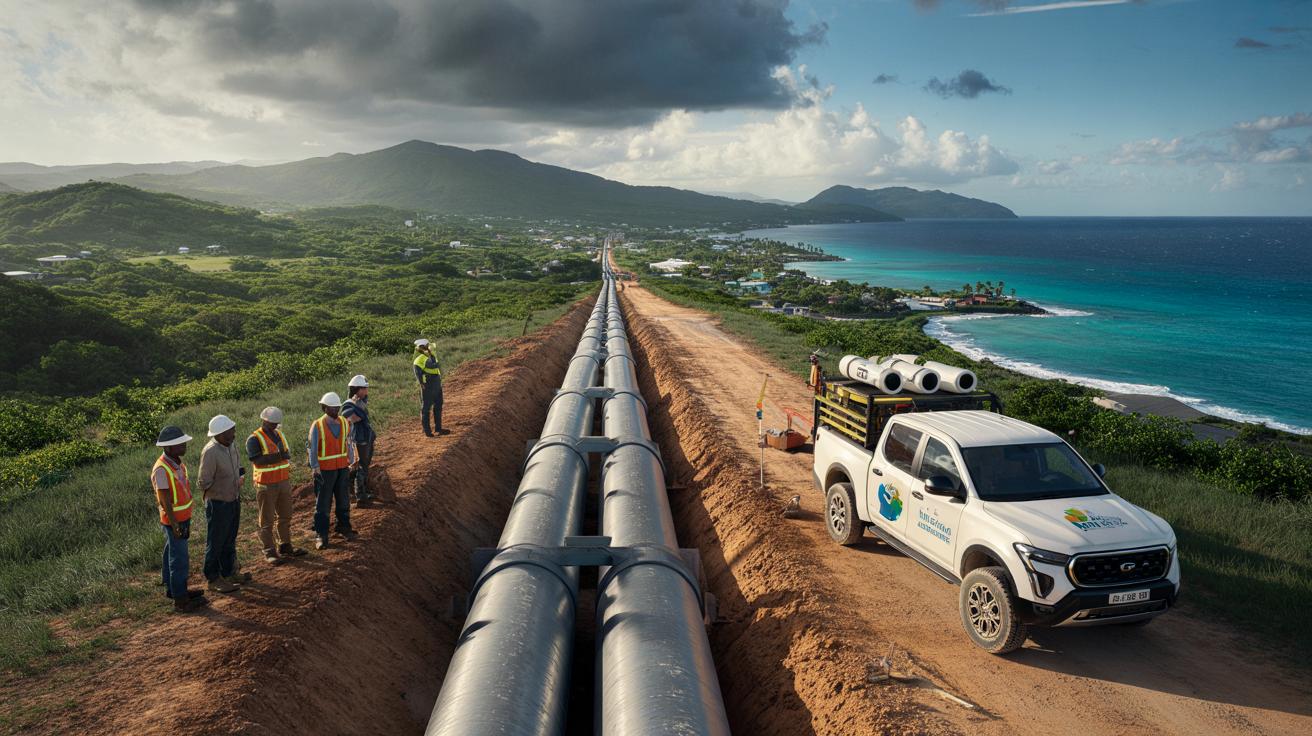
Jamaica, the Caribbean’s third-largest island, has awarded Vinci Construction Grands Projets a contract worth around €144 million to design and build 68 kilometres of new drinking water pipelines in the northwest of the country.
The project forms part of the Western Water Resilience Project, a flagship national programme aimed at stabilising supplies in a region regularly hit by drought and storms. It extends earlier works already launched by the Jamaican government as it reframes water as a strategic asset, not just a public service.
A 68 km pipeline network, designed to last over 50 years, will become one of Jamaica’s backbone systems for safe drinking water.
The new pipelines will feed communities that hug the coast around Montego Bay and neighbouring districts, where most of the island’s 2.8 million residents live. The centre of Jamaica, dominated by the Blue Mountains and high plateaus, remains far less populated but plays a crucial role as a water catchment area.
Why Jamaica called for outside help
Climate pressure forces a rethink
Rain in Jamaica rarely falls where people actually live, or at the times when they most need it. That mismatch has grown sharper as climate change bites.
In July 2025, the Jamaican government released 350 million Jamaican dollars (about €1.9 million) in emergency funds to cope with a broad decline in rainfall and falling reservoir levels. That package financed water trucking to thirsty communities, temporary storage tanks for vulnerable households, and urgent support for critical infrastructure such as hospitals and schools.
At the same time, Kingston pushed ahead with deeper reforms. Around 22 billion Jamaican dollars (roughly €119 million) have been channelled into long-term projects for drinking water, sanitation, and irrigation, targeting more than 900,000 residents across the island.
Those investments include the Rio Cobre water supply system, designed to provide about 57,000 cubic metres of drinking water per day and avoid a repeat of the 2022 drought that hit Kingston and St Andrew. The new Vinci contract in the northwest plugs directly into this wider effort.
➡️ Wie du eine verbrannte Pfanne mit einer Chef‑Methode auf Salzbasis rettest
➡️ «Ich spare 30 Minuten pro Woche»: Diese Methode zum Fensterputzen geht ultraschnell
➡️ Einen Korken in den Kühlschrank legen: Der einfache Trick gegen Ihr wirklich größtes Problem
Jamaica now treats water security as a national security issue, not just a utility bill.
An island shaped by extremes
Jamaica’s geography makes water management especially tricky. The island stretches over nearly 11,000 square kilometres, with a spine of mountains rising above 2,200 metres in the Blue Mountains. A narrow coastal strip houses most cities and tourist resorts, while the interior is sparsely populated.
Weather patterns swing between intense dry seasons and cyclone-hit months. Heavy rains on steep slopes run quickly to the sea, often bypassing infrastructure designed for gentler conditions. When droughts come, rivers shrink and older pipes leak away precious reserves.
Against that backdrop, a continuous, robust network of pipes becomes a critical tool that can shift water from where it is captured to where it is actually needed.
What Vinci will build on the ground
68 kilometres of pipes, 130 kilometres of real-world challenges
On paper, the project calls for 68 km of new large-diameter ductile iron pipelines. In reality, the route sprawls across almost 130 km of ground when you add bends, detours, and work zones.
The alignment follows existing roads where possible, skirts built-up areas and avoids known risk zones such as unstable slopes and protected wetlands. Each curve comes with technical constraints: steep gradients, soft soils, river crossings, or areas prone to landslides during hurricane season.
The pipes will be made from ductile iron, a material prized for its resistance to corrosion, pressure variations and ground movement—three issues that can rapidly cripple a water system in a tropical island setting. The design aims for a service life exceeding 50 years with proper maintenance.
The construction phase will run for about 36 months. Around 100 people will be mobilised full-time: engineers, surveyors, heavy machinery operators, welders, environmental specialists and local workers.
The site will function like a moving technical village, advancing step by step across northwest Jamaica.
Working with ecosystems, not against them
The project is being carried out in close coordination with Jamaica’s National Environment and Planning Agency. The goal is not just to lay an efficient pipe, but to do so while minimising long-term scars on sensitive environments.
Every river crossing is treated as a bespoke operation. Teams assess where to pass, how deep to bury the pipe, and which installation technique to use. In some cases, they will drill underneath riverbeds rather than open them, limiting sediment disturbance and impacts on aquatic life.
The work schedule is adjusted to take into account breeding seasons for certain species and periods of heavy rainfall when erosion risk is highest. The result is a slower, more deliberate project, but one that aims to leave ecosystems in workable condition once machinery moves on.
A long relationship between France and Jamaica’s water sector
Experience built over decades
Vinci has operated in Jamaica since 1999 and already has a track record with the country’s water system. Its teams know how local soils react after cyclones, how roads behave under heavy rain, and which regions tend to fail first during extended droughts.
That experience became very visible in 2025, when Hurricane Melissa hit the island. Vinci crews took part in emergency repairs to restore drinking water to Montego Bay, the country’s second-largest city. The work happened under intense time pressure, with damaged bridges, flooded access roads and shaken infrastructure.
This local knowledge now feeds into the design of the new northwest network, from the choice of pipe materials to the placing of valves and pressure control points.
A global specialist in complex water networks
The Jamaican contract sits alongside a roster of similar water infrastructure projects Vinci has delivered in harsh environments around the world.
| Country | Type of project | Main challenges |
| Qatar | Urban drinking and treated water networks around Doha | Extreme heat, aggressive desert soils, rapid urban growth |
| Australia | Long-distance pipelines to secure city supplies | Prolonged droughts, long routes, climate extremes |
| Morocco | Major drinking water networks for large cities | Dense urban areas, sensitive crossings, environmental rules |
| Algeria | Large-diameter pipes linking dams, plants and cities | Mountainous terrain, population growth, service continuity |
| Chile & Peru | Long-distance transfer pipelines | Andean relief, seismic risk, high altitudes |
These projects all share one theme: building reliable water systems under intense climatic or geological stress. Jamaica’s combination of mountains, hurricanes and droughts fits right into that portfolio.
How the new network could change daily life
From leak-prone pipes to stable service
Jamaica faces the same problem as many countries: a high share of “non-revenue water”. That term covers leaks, illegal connections and metering errors that mean large volumes of treated water never generate income or reach customers.
By installing strong, large-diameter pipes with better pressure control, the northwest project should reduce bursts and leaks along the main trunk lines. When major pipes hold steady, smaller distribution lines downstream also suffer less stress.
Residents in affected areas can expect fewer unexplained supply cuts, less need for water trucks, and a lower risk of contamination entering cracked pipes. Hospitals, hotels and schools gain more predictable service, which matters directly for tourism and public health.
- Households: more regular tap water, fewer days relying on stored rainwater or bottled supplies
- Tourism operators: better planning for hotels and resorts, reduced need for costly on-site storage
- Farmers: clearer prospects for irrigation connections in future phases
- Local authorities: improved control of pressure and losses across the system
Knock-on effects across the island
A modern water grid does not operate as isolated pieces. Each new segment changes the balance of flows across the wider system. A robust trunk line in the northwest can relieve pressure on overused sources elsewhere, or provide redundancy when another region faces drought.
Combined with the Rio Cobre treatment plant, now under development with Vinci’s involvement, the island moves closer to a more interconnected model where water can be shifted with less loss and less crisis management.
Key concepts and future risks
Why “national water security” matters
The Jamaican government increasingly treats water the way countries often treat energy or food: as a strategic security concern. That shift reflects several converging risks.
- Climate shifts: longer dry seasons and more intense storms
- Urbanisation: growing demand around Kingston and coastal resorts
- Ageing infrastructure: old pipes, limited redundancy, and chronic leaks
- Economic pressure: tourism and agriculture both depend on reliable water
When these factors coincide—say, a drought followed by a hurricane that damages treatment plants—governments face a real risk of service collapse. Upgraded networks and large-capacity plants reduce that vulnerability, even if they cannot erase climate shocks altogether.
Scenarios for the next decade
If the northwest project performs as planned, Jamaica could use it as a template for other regions, with a stronger focus on leak detection, pressure zoning and integration with smart metering. That would gradually lower losses and free up capacity without tapping new rivers or building extra dams.
The opposite scenario also exists: rising temperatures, population growth and limited funding outpacing the gains from new infrastructure. In that case, measures like stricter demand management, tiered tariffs and rainwater harvesting could become more widespread complements to large engineering projects.
For now, though, the €144 million partnership between Jamaica and France’s Vinci marks a clear bet: that carefully designed pipes, laid with an eye on both climate and ecology, can anchor the island’s water future for decades to come.