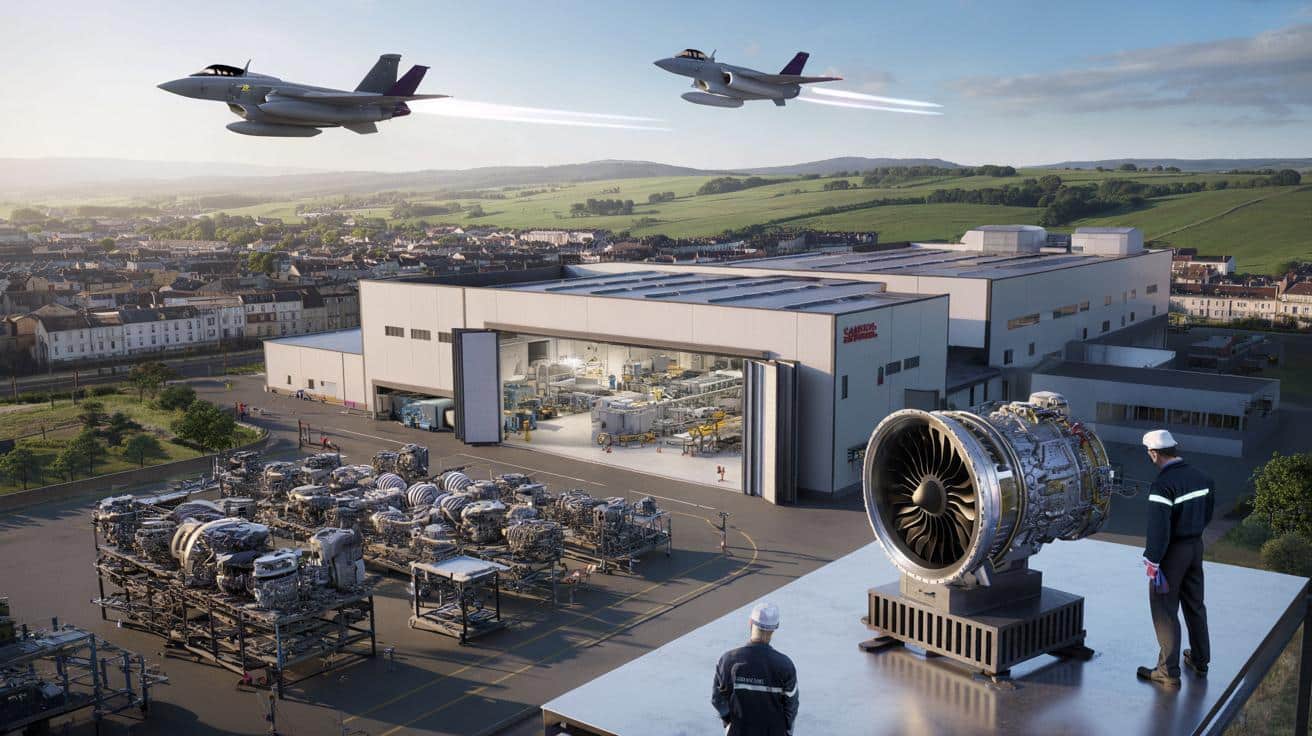
On the surface, Le Creusot still looks like a classic steel town. Yet inside Safran’s workshops, France is quietly building a second industrial backbone for the Rafale fighter jet, backed by a fresh €70 million investment and a shift from civil aviation parts to highly sensitive military engine components.
Safran turns a civil plant into a Rafale engine stronghold
Safran Aircraft Engines has confirmed a major expansion of its site in Le Creusot, in eastern France. The group plans to pour €70 million into the factory, which will be extended by 9,000 square metres and progressively retooled to produce complex rotating parts for several strategic engines.
Le Creusot is on track to become one of France’s main industrial sites for manufacturing key components of the Rafale’s M88 engine.
Until now, the Burgundian facility had a very narrow mission. It machined low-pressure turbine discs for LEAP and CFM56 engines, the workhorses that power large fleets of Airbus A320 and Boeing 737 aircraft. High-precision work, but confined to the civil aviation ecosystem.
The new project changes the game. The plant will add production lines for complex rotating parts used in:
- the M88 engine, which powers the Rafale fighter jet, including its upgraded M88 T-REX variant
- the GE90, one of the most powerful civil turbofan engines ever built, used on Boeing 777 aircraft
By 2029, when the extension is expected to be fully operational, Le Creusot will no longer be a specialist serving only civil airliners. It will stand as a twin pillar, alongside Safran’s Évry-Corbeil site near Paris, for critical Rafale engine components.
Ramping up to secure Rafale export demand
The timing is not accidental. Dassault Aviation’s Rafale has stacked up export orders in recent years, with well over 200 aircraft on firm order across countries such as Egypt, India and Greece. Each jet carries two M88 engines, and export contracts often include long-term support packages.
Safran must therefore guarantee engine deliveries and spare parts over decades, not just the next few years. Le Creusot will act as a second industrial source for complex rotating parts of the M88, mirroring and backing up production at Évry-Corbeil.
The goal is industrial redundancy: if one site slows down, the other can keep the Rafale supply chain running.
➡️ Kein Pulli, keine Feuchttücher: der neue Trick, der Brillengläser wieder wie neu macht
➡️ Wie du eine verbrannte Pfanne mit einer Chef‑Methode auf Salzbasis rettest
➡️ China ‘revives’ a 50-year-old technology that uses 200 times less energy than digital computing
➡️ Flughafenmitarbeiterin verrät den Trick, damit Ihr Koffer als Erster aufs Band kommt
➡️ Heating off at night: money-saving trick or costly mistake?
This redundancy is a central concern for the French state. Fighter jet engines sit at the very core of national sovereignty. A failure in production, whether caused by a supply chain disruption, a cyberattack or a political shock, would immediately weaken the country’s military readiness and its credibility as an exporter.
Inside the M88: the Rafale’s compact powerhouse
The M88 is a compact, afterburning turbofan specifically developed for the Rafale. It has a high thrust-to-weight ratio and a modular design that eases maintenance and upgrades.
| Engine | M88 (Safran Aircraft Engines) |
| Type | Low-bypass, afterburning turbofan, modular architecture |
| Dry thrust | About 50 kN |
| Thrust with afterburner | About 75 kN (standard); up to ~90 kN on M88 T-REX |
| Key feature | High thrust-to-weight ratio and rapid maintenance thanks to modular design |
The upcoming M88 T-REX upgrade aims to boost thrust for future Rafale F5 variants, while next-generation versions may push performance even higher. All these evolutions require extremely robust discs and rotating parts, capable of withstanding enormous temperatures and rotational speeds.
A factory extension built around “lights-out” machining
Le Creusot is not being expanded with old-school heavy industry in mind. Safran already uses the site as a showcase for advanced manufacturing methods, and the new building will reinforce that approach.
The plant leans heavily on so-called “closed door” or “lights-out” machining. These are clusters of highly automated machine tools that can operate for long stretches without human intervention, including at night. Once the doors close, the machining centres run, sensors monitor every operation and data flows to central systems.
For turbine discs and rotating parts, repeatability matters almost as much as raw mechanical strength.
Automated cells reduce the risk of human error while enabling very tight tolerances. In the context of aircraft engines, a fault in a rotating part can have catastrophic consequences. Safran’s strategy mixes highly skilled operators, who handle programming, set-up and inspection, with advanced robotics and digital monitoring.
From 200 to 300 jobs in a historic industrial region
Today, the Le Creusot site employs roughly 200 people. Safran forecasts around 300 jobs by 2032 once the new lines reach steady-state production. That figure may not sound spectacular, but it matters deeply in a town whose identity has long been tied to heavy industry and metallurgy.
The project will require intensive training, as staff shift from civil turbine discs to parts for military engines with even tighter margins for error. Technicians and engineers will need skills in advanced materials, non-destructive testing, complex metrology and digital manufacturing systems.
- New hires in machining and industrial maintenance
- Upskilling for existing staff on military engine standards
- Closer ties with local technical schools and engineering institutes
In the French aerospace sector, which often struggles to attract enough qualified technicians, such investments help stabilise local employment and keep young workers in industrial careers rather than pushing them into services or away from the region.
Strategic geography: a dense industrial network inside France
Le Creusot is only one piece of a wider Safran puzzle spread across France. The company relies on a dense network of factories and research sites, many of them dating back decades, sometimes to the early days of jet propulsion.
| Site | Region | Main role |
| Villaroche | Seine-et-Marne | Assembly and testing of civil and military engines |
| Évry-Corbeil | Essonne | Complex rotating parts for the M88 and other engines |
| Le Creusot | Saône-et-Loire | Machining of discs and complex rotating components |
| Gennevilliers | Hauts-de-Seine | Maintenance and repair of engines |
This network gives France a rare capability: from forging to final assembly, many critical steps for engines like the M88 stay under national control. For export customers, that translates into long-term support and fewer uncertainties tied to foreign suppliers.
Why rotating parts are so sensitive
Rotating components in a jet engine, such as turbine and compressor discs, face brutal conditions. They spin at tens of thousands of revolutions per minute, endure temperatures approaching 2,000°C in some zones and carry huge mechanical loads.
A microscopic defect in a turbine disc can grow into a crack and, in the worst case, cause an engine failure.
This is why these parts are treated almost like strategic assets. They require sophisticated alloys, carefully controlled heat treatments and a whole battery of inspections: ultrasonic testing, X-rays, surface analysis and dimensional checks measured in microns.
By adding capacity for such components in Le Creusot, Safran reduces its dependence on a single site and shortens some of its internal supply chains. That can limit delays during surges in demand, whether for new Rafales or heavy maintenance cycles.
What this means for future conflicts and export markets
From a defence perspective, the expansion in Burgundy acts as a form of insurance. Imagine a scenario where tensions rise and France has to accelerate Rafale deliveries to an ally, while also keeping its own fleet at high readiness. Multiple domestic sites able to produce critical engine parts give far more room for manoeuvre.
On the export side, countries buying the Rafale ask recurring questions: Will spare parts arrive on time? Are there bottlenecks in the engine supply chain? Can the manufacturer still deliver if geopolitical conditions shift?
A strengthened, diversified industrial base inside France offers more reassuring answers. For nations considering a long-term fighter fleet, that stability can weigh heavily against rival offers, even where aircraft performance looks similar on paper.
Key terms and practical takeaways
For readers less familiar with engine jargon, a few concepts help make sense of Safran’s bet on Le Creusot:
- Complex rotating parts: components such as turbine or compressor discs, which spin at very high speed and must never fail in service.
- Closed door machining: highly automated machining cells that run with minimal human presence, boosting consistency and productivity.
- Industrial redundancy: having at least two domestic sources for critical parts, so a single failure does not halt production.
One practical scenario shows the value of this setup. Suppose a design upgrade to the M88 requires new manufacturing steps that temporarily slow production at Évry-Corbeil. With Le Creusot fully tooled up, Safran can shift part of the workload, keep export schedules on track and avoid a cascade of delays across assembly lines and air forces waiting for their aircraft.
There are risks, of course. Recruiting specialised staff in sufficient numbers is not guaranteed. Global competition for machinists and engineers remains intense, and demand in civil aviation is recovering alongside defence. Yet the commitment of €70 million, the clear role within the Rafale programme and a long pipeline of engines and upgrades give the Burgundy plant a visibility that many industrial sites lack, making it a more attractive bet for young workers planning their careers.