Something shifted at home.
Across living rooms and tiny flats, many owners quietly admit it: the cat has more say than anyone else. From wake-up times to sofa seating plans, our supposedly domesticated feline companions seem to set the rules, not follow them. But is this genuine domination, or just very smart survival strategy with a furry face?
How a small predator takes over a big flat
Domestic cats may look relaxed, but their behaviour inside a home follows a sharp territorial logic. They don’t just flop down “wherever”. They select locations the way a tactician would: for visibility, safety and control.
High spots are their favourite. The top of a wardrobe, a bookcase, the back of a sofa, even a fridge — all become watchtowers. From up there, a cat can track every movement in the home while staying just out of reach.
Cats transform vertical space into a control system: the higher the perch, the wider the view and the safer they feel.
Then there are the choke points. Corridors, door thresholds, the exact middle of the kitchen floor — these are not random nap sites. By placing their body where everyone must pass, cats gain a strange kind of gatekeeping power. You adjust your path. You step wide, slow down, or even stop to avoid them.
On a chemical level, that space becomes theirs too. Rubbing their cheeks on doorframes and furniture releases pheromones. These invisible markers say: “This area is part of my zone.” To you, it’s a hallway. To your cat, it’s a border crossing.
The sofa, the bed and the silent negotiations
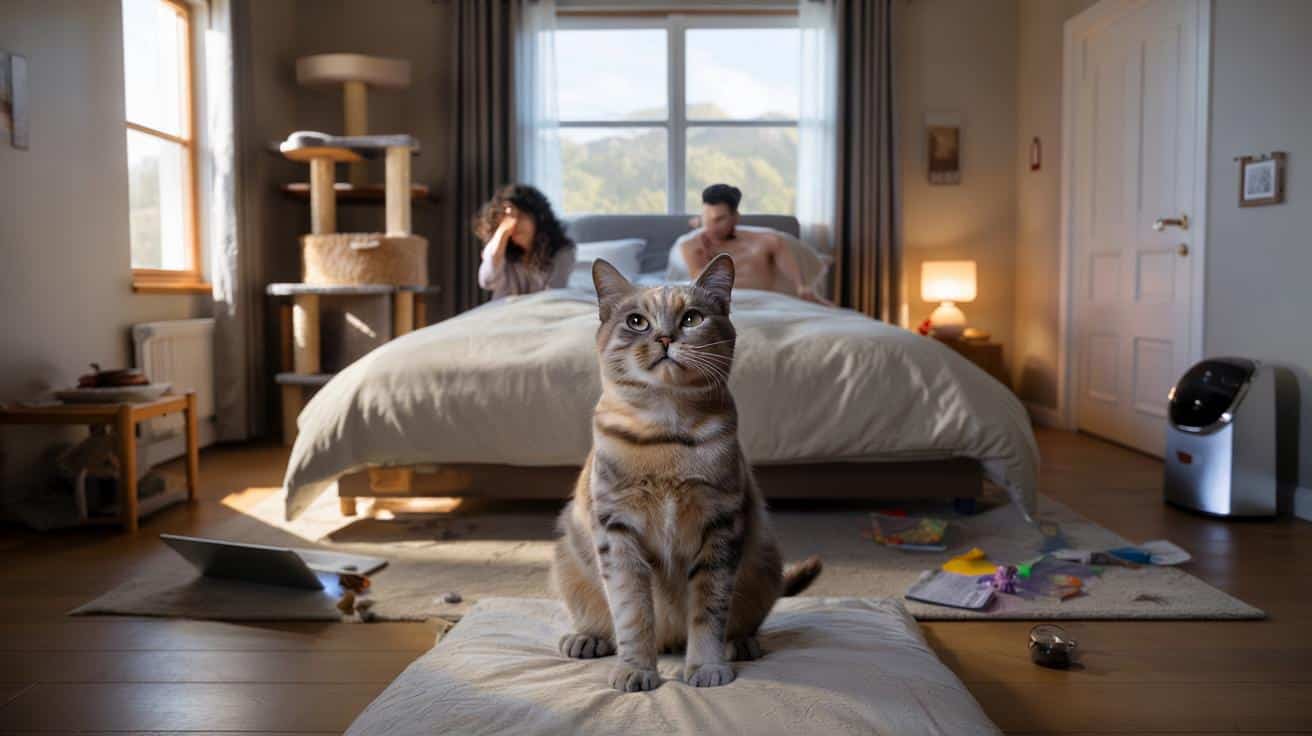
The best soft surfaces are rarely free-for-all areas. Many owners unconsciously negotiate around their cat. You sit on the narrow edge of the sofa so you don’t disturb that perfectly curled ball of fur. You sleep in an uncomfortable position because the cat has chosen the middle of the bed.
These micro-adjustments might look trivial, but they show who is adapting to whom. Over time, humans learn the “cat rules”: this cushion is off limits, that blanket is not to be moved, and heaven help you if you sit in the sunbeam first.
- Sofa rule: you move, cat stays.
- Bed rule: your leg goes numb, cat remains undisturbed.
- Desk rule: laptop waits, cat stretches.
None of this means your pet is a villain plotting conquest. But it does show how a cat can quietly bend the household layout to its advantage.
➡️ The ancients always prepared their soil this way in February: their harvests were twice as abundant
➡️ «Ich spare 30 Minuten pro Woche»: Diese Methode zum Fensterputzen geht ultraschnell
➡️ Experten warnen: Das bedeuten diese Löcher in Ihrem Garten – und warum Sie wachsam bleiben sollten
➡️ My cat is gone“: the urgent steps that boost your chances of finding them again
When your alarm clock has whiskers
Space is only half the story. Time is the other battlefield, and many cats are excellent at rewriting your daily schedule.
Cats are naturally more active at dawn and dusk. In a flat or house, though, they quickly realise that one particular “resource” — you — is only fully responsive at certain hours. So they experiment.
The 5am forehead tap, the insistent meow by the bedroom door, the claws gently working on the duvet: this is not random fussiness. It is conditioning.
Every time you get up early to feed a nagging cat, you teach them that waking you equals food, attention or both.
Behaviourists see this as classic operant conditioning, just reversed. Instead of you training the cat, the cat trains you. They repeat what works. If the paw to the nose gets you out of bed faster than a polite meow, guess which tactic becomes the routine.
Taking back the morning without a fight
Changing this rhythm requires consistency, not punishment. One widely recommended tactic is to break the link between “waking up” and “feeding time”. Get up, ignore the food bowl, and do something else first: shower, make coffee, read the news.
After a few days or weeks, your cat stops seeing your first movement as a direct trigger for breakfast. The fuss may increase briefly before it eases — a phase behaviour experts call an “extinction burst”, where the animal tries harder when a strategy stops paying off.
Automatic feeders can also shift power. If breakfast appears from a machine at 6:30am, the cat no longer needs to poke the human at 5:59. You become less central to the food schedule, which can slightly reduce that feeling of feline control.
Is this really domination, or just smart survival?
Talking about a cat “ruling” a house can sound like a joke, but the underlying question is serious: do cats seek power, or predictability?
Modern research tends to support the second idea. Cats are creatures of habit that dislike sudden changes. Predictable routines reduce their stress and help them feel secure. That drive for stability can look like bossiness: insisting doors stay open, demanding meals on time, reacting strongly to moved furniture.
What feels like tyranny often comes from a basic need: control over territory, resources and routine to stay safe.
That said, some cats do show behaviours that resemble dominance in multi-cat households: blocking access to food bowls, guarding litter trays, or stalking timid companions. Around humans, the same instincts can surface in subtler ways — monopolising the best spots, guarding doorways, or swatting when you pass.
Three pillars of feline “power” at home
| Area | What the cat does | Effect on humans |
|---|---|---|
| Space | Occupies high places and key passageways | People walk around, adjust where they sit or sleep |
| Resources | Controls access to food spots, litter, favourite rooms | Owners change layouts and timing to avoid stress |
| Routine | Insists on set times for meals, play, attention | Daily schedule gradually bends around the cat |
Calling this a “coup” says more about us than them. We read human-style motivations into an animal that, at its core, just wants safety, comfort and reliable access to what it needs.
How to live with a “house ruler” without losing your mind
Accepting that your cat shapes the home doesn’t mean giving up all control. Small environmental and behavioural tweaks can balance the relationship.
Adjust the territory, not the affection
Giving the cat multiple high perches around the house can reduce competition over one prized spot. Wall shelves, window hammocks and sturdy cat trees spread out their “lookouts”. This often leads to fewer confrontations at doorways or on the back of the sofa.
Adding more than one litter tray, water bowl and resting place also limits resource guarding. The general guideline many vets use is: number of cats + 1 for litter boxes, adjusted for space constraints.
Structured play in the evening helps too. Short, intense sessions with a fishing-rod toy or laser pointer burn off hunting energy before bedtime. A tired cat is less inclined to stage 4am hallway sprints.
Reading the small signs before they escalate
Some “dominating” behaviours are early warnings of stress. A cat that suddenly blocks doors, growls when moved, or becomes obsessed with controlling access to one room might be anxious or unwell.
Key signs worth noting include:
- Increased aggression when you approach certain spots.
- Refusal to use the litter tray if another animal is nearby.
- Constant pacing between doors or windows.
- Clinginess followed by sharp, defensive reactions.
In such cases, a vet check is useful to rule out pain or illness. If health is fine, a behaviourist can suggest ways to adjust the environment, enrich the cat’s life and reduce the sense of needing to “control everything”.
Why we so often feel outsmarted
Part of the fascination comes from how cats manipulate cause and effect. They notice patterns fast: this noise gets the door opened, that meow gets the treat, this stare makes the human stand up. Many owners report that their cat seems to “press buttons” — performing specific actions that reliably trigger a human response.
From a psychological angle, this is a neat example of what scientists call “contingency learning”: understanding that one event leads to another. We use it all the time, but so do they. The difference is that we rarely notice they’re doing it to us.
Imagine a simple scenario: every evening, you sit on the sofa at 8pm and your cat jumps up for cuddles. One day, you’re late. The cat waits, then starts pawing the remote, meowing at the sofa, or pacing in front of you. They’re not just seeking affection; they’re flagging a broken routine. When you finally sit, the pattern resets — and the cat learns that persistence sometimes repairs their schedule.
Understanding these mechanisms takes some of the mystery out of your “tiny tyrant”. The cat that seems to rule the roost is often just highly efficient at adjusting a shared environment to meet its needs, while you quietly adjust yours around it — usually without even noticing who changed first.