The idea sounds reassuringly simple – burn less gas or electricity, spend less money. But how your home reacts when the heat goes off, and what happens the next morning, can make the difference between real savings and an unexpected bill shock.
Why the “heating off at night” debate is so divisive
Across Europe, around half to two-thirds of a home’s energy use is swallowed by heating. In France, the national energy agency ADEME estimates it at roughly 60% of a typical household’s bill. In the UK and US, the proportions are different but the trend is similar: heating is the heavyweight.
Against that backdrop, cutting the boiler overnight looks like low‑hanging fruit. That’s especially true for people who grew up being told that radiators ticking away while you sleep are a waste of money.
Killing the heating every night can feel like a sensible act of discipline, but the physics of your home may not agree with you.
The crucial question is not what happens when you turn the heating off, but how much energy is needed to bring your home back to a comfortable temperature the next day.
The hidden cost of letting your home get too cold
When the heating stops, your home does not cool evenly. The air temperature drops first. Then the walls, floors and furniture slowly release the heat they stored during the day. In a poorly insulated building, that stored warmth vanishes quickly.
By morning, you are not just reheating the air; you are reheating the entire building fabric. That can be energy‑hungry. Some studies and field tests suggest that a very aggressive overnight setback, followed by a hard morning “boost”, can use up to 20% more energy than a gentle, controlled reduction.
Heat loss is driven by the temperature difference between indoors and outdoors. If it is close to freezing outside and your home is allowed to drop to 11–12°C, that gap grows. The colder the building, the more heat it will greedily absorb when the boiler starts roaring again.
Allowing the house to plunge in temperature every night can turn the morning warm‑up into the most expensive part of your day.
➡️ Veterinäre geben wichtige Warnung an alle Katzenbesitzer heraus
➡️ This simple winter habit promises hydrangeas smothered in blooms this spring
➡️ Einen Korken in den Kühlschrank legen: Der einfache Trick gegen Ihr wirklich größtes Problem
➡️ Salz im Spülmittel: ein genialer Trick, der Ihr größtes Küchenproblem löst
➡️ Experten warnen: Das bedeuten diese Löcher in Ihrem Garten – und warum Sie wachsam bleiben sollten
There is also comfort to think about. Stone floors, tiled bathrooms and outside walls can feel icy long after the thermostat claims the house is “warm”, pushing some people to crank the heating higher than they usually would.
Turn it off or turn it down? What experts actually suggest
Heating engineers and energy agencies tend to give fairly similar advice: for most homes, especially older ones, it is usually better to turn the heating down at night rather than off completely.
For sleeping, a cooler room is not just tolerable but often healthier. Many experts point to a bedroom temperature of around 16–17°C as a good target. That is lower than daytime comfort levels, but high enough to stop walls and furniture getting painfully cold.
Recommended temperatures room by room
Energy agencies in Europe use guidelines like the ones below. They vary slightly by country, but the pattern is consistent: gentle reductions at night, not extreme drops.
| Room | Typical daytime setting (°C) | Suggested night-time setting (°C) |
|---|---|---|
| Bedroom | 16–18 | 16 |
| Living room | 19–21 | 17 |
| Bathroom | 22 | 17 |
| Kitchen | 18–20 | 16 |
These are not strict rules. They are starting points that balance comfort, health and energy use. The message is clear: a few degrees down is helpful; a nightly deep-freeze is rarely a bargain.
Why a programmable thermostat quietly pays for itself
If regularly walking around the house to tweak radiator valves sounds tedious, there is a reason the programmable thermostat has become a standard recommendation.
- Automatic night setback: The thermostat can lower the temperature by a couple of degrees at bedtime, then gently bring it back up before you wake.
- Fewer big swings: Smooth temperature curves tend to use less energy than daily roller‑coasters of hot and cold.
- Custom schedules: Weekdays, weekends, working from home – each pattern can have its own programme.
A well‑set thermostat is less about gadgets and more about avoiding the cost of your own forgetfulness.
Smart thermostats go further by “learning” how quickly your home heats and cools, and by adapting to weather forecasts. But even a basic programmable model can deliver noticeable gains if used consistently.
When turning the heating off at night can make sense
There are still situations where switching off entirely is logical and safe.
Extended absences
If nobody is home for several days, maintaining normal comfort levels makes little sense. Many heating systems offer a frost‑protection or “holiday” mode, which keeps the property at around 12–14°C. That protects pipes and building fabric while cutting energy use sharply.
Very efficient, well-insulated homes
New‑build properties with high‑grade insulation and modern glazing lose far less heat overnight. Some homes with underfloor heating or advanced heat pumps are designed to run at lower, steady temperatures anyway.
In such cases, a bigger nighttime setback – or even an off period – might still deliver savings, because the home cools slowly and barely needs a morning surge.
Insulation and maintenance: the quiet heroes
No thermostat can fully compensate for a leaky building. Gaps around windows, uninsulated lofts and bare floors allow heat to escape, so the home cools quickly as soon as the boiler relaxes.
- Insulation upgrades: Loft insulation, cavity wall filling and modern windows dramatically slow heat loss and make gentle setbacks more efficient.
- Radiator care: Bleeding radiators to remove trapped air and checking that valves work properly helps each unit deliver the warmth you are paying for.
- Boiler servicing: An annual check keeps gas or oil boilers running efficiently and can flag safety problems early.
Even small, low‑cost tweaks such as draught excluders, heavy curtains at night and closing doors between rooms can reduce how far the temperature drops when the heating is off or turned down.
What actually happens on your bill? A simple scenario
Imagine a typical three‑bedroom house kept at 20°C all day. The owner decides on two different strategies for winter nights.
Scenario A: total shutdown from 11pm to 6am
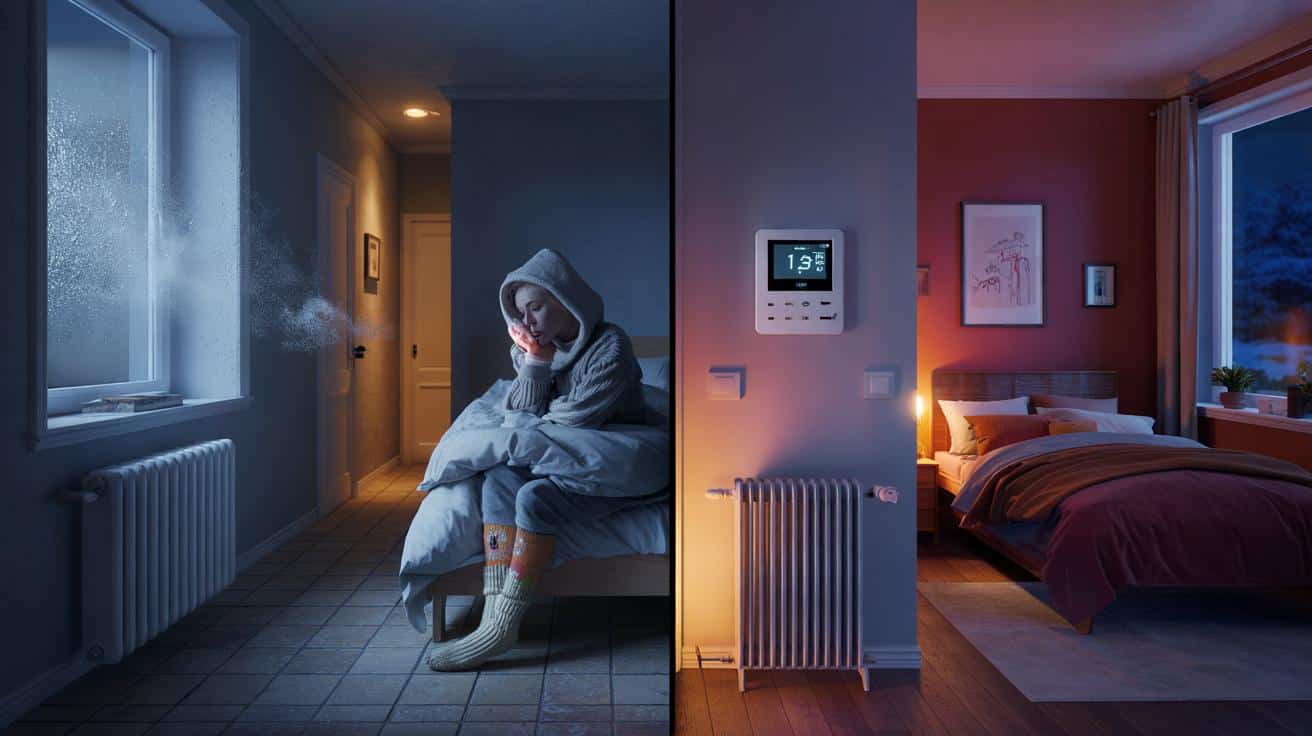
The heating goes off completely. Outside, it is 3°C. By morning, much of the house is at 13–14°C. When the system restarts, it runs flat out for an hour or more to bring the air, walls and floors back up to 19–20°C. The boiler works hard, and occupants feel chilly for some time.
Scenario B: setback from 20°C to 17°C
The thermostat automatically drops the target temperature at 11pm. The house cools slowly overnight. By 6am, many rooms are at 17–18°C. The boiler kicks in gently and only needs a modest boost to restore full comfort before breakfast.
In a poorly insulated property, Scenario A can end up using as much or more energy than Scenario B, despite seven hours technically “off”. In a highly insulated new build, the gap between the two could be smaller, but the comfort difference remains large.
Key terms worth unpacking
Thermal inertia: This describes how slowly a building heats up and cools down. Heavy materials like brick and concrete hold heat longer than lightweight structures. Homes with high thermal inertia are less sensitive to short heating breaks but take longer to warm up from cold.
Setback temperature: This is the reduced target temperature used when you are asleep or away. It is not an off switch; it is a lower gear that trims energy use without letting the house plunge into the cold zone.
Frost protection mode: Many boilers and heat pumps include a low‑level setting, typically around 7–12°C, to stop pipes freezing while you are away for holidays or during a cold snap.
Practical combinations that work in real life
For many households, the sweet spot lies in combining several tactics rather than relying on one dramatic gesture like “no heating at night”. A realistic routine could look like this:
- Daytime at 19–20°C in living areas, slightly cooler in bedrooms.
- Automatic setback to 16–17°C across most rooms from around 11pm.
- Timed warm‑up starting 30–60 minutes before waking, to avoid a cold start.
- Draught‑proofing and insulated curtains to slow heat loss during the night.
Layered clothing, warm bedding and small behavioural shifts – closing doors, not blocking radiators with furniture, airing rooms briefly rather than leaving windows ajar – all add up. None of these steps is dramatic on its own, but together they reduce how far the temperature falls, so the heating system does not have to work so hard when it restarts.
The big question is not simply “off or on”, but how gently you let your home cool, how well it holds that heat, and how smartly you bring the warmth back in the morning. For many homes, a controlled setback wins that argument far more often than a nightly blackout.