The first time you notice it is often something tiny. You’re standing in your living room, phone in hand, scrolling, and suddenly you wobble for no reason. Your toes claw into the carpet to stop you from toppling over. You laugh it off, but there’s a flicker of unease. When did simply standing still start to feel like work?
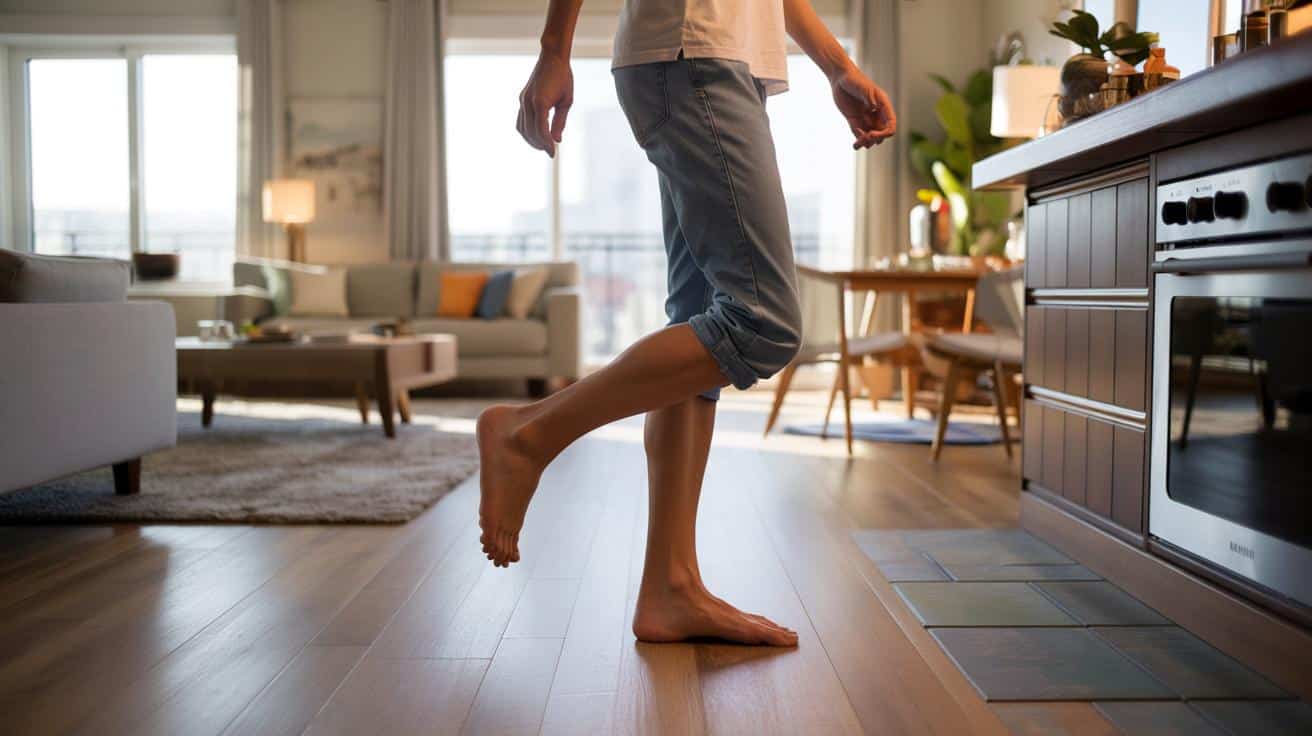
Then one evening you kick off your slippers after a long day and walk barefoot to the kitchen. The floor is cool, a bit rough under the heel, and your whole body seems to exhale. Your steps slow down. Your back straightens without you forcing it. You feel… different.
That’s where the quiet revolution often starts.
Warum barfuß auf dem Parkett plötzlich Sinn ergibt
If you watch kids, they rarely stand still in shoes at home. They bounce, grab the floor with their toes, shift from one leg to the other. Their balance is alive. Somewhere between school, Bürojob and weiche Hausschuhe, many adults lost that constant micro-training. Walking barefoot in the apartment looks like a lazy Sunday habit, yet for your body it’s a daily workout in disguise.
Those few millimetres of lost cushioning wake up the tiny Muskeln in your feet, Knöchel and core. Your nervous system starts getting richer information from the ground. Without thinking, you correct your posture. Step by step, literally.
A physio in Berlin told me about a client in his mid‑40s. No big sports injury, just this low-level wobbliness and a nagging lower back. He sat all day, wore super-dämpfende Sneakers at home, and felt “alt auf glattem Boden”. The therapist suggested something that sounded almost ridiculous: barefoot time in the Wohnung, every single evening.
The man started with five Minuten while cooking. After a month he could stand on one Bein in front of the Spülmaschine without shaking. Three months later, his smartwatch showed fewer “stille” Minuten, because his body fidgeted and stabilised more. His posture on Zoom calls? Noticeably more upright, colleagues joked he’d grown.
What’s actually happening is surprisingly logical. Your feet are full of Sensoren, almost like a second set of hands. Cushioned slippers mute a lot of those signals. Barefoot, your brain suddenly receives clear feedback: here’s a tiny Unebenheit, there’s a slippy tile, that floorboard dips a little. Every step forces a micro-adjustment in your Fußgewölbe, Knie and Hüfte.
Over time these micro-movements strengthen the Tiefenmuskulatur that keeps you stable. Your body re-learns a more neutral stance because it can “read” the ground better. The result doesn’t arrive with a big fanfare. It sneaks in the day you realise you can reach for the top shelf without bracing yourself on the counter.
So startest du mit dem Mini‑Training im Wohnzimmer
Begin small, almost absurdly small. Take off your Hausschuhe for the last ten minutes of your evening routine. Walk from Sofa to Küche, stand barfuß beim Zähneputzen, maybe do one extra Runde to turn off the lights. Feel the Unterschied between Fliesen, Teppich and Holz. Don’t try to “walk correctly”. Just notice.
On day three or four, add a quiet ritual: stand with feet hüftbreit, soften your Knie, and let your Gewicht gently shift from Ferse to Ballen. Twenty slow Atemzüge, that’s it. That tiny wobble you feel? That’s your Gleichgewicht waking up from a long nap.
A common trap is the “Alles oder nichts”-Ansatz. People read about barefoot benefits, peel off their Schuhe for hours on harte Fliesen, and end up with brennende Fußsohlen or a sore Achilles. Let’s be honest: nobody really does this every single day without a hiccup. Bodies need time and kindness, not heroics.
If your Füße empfindlich are, sprinkle your route with Inseln: a Yogamatte in the Bad, a Teppichläufer im Flur, maybe ein alter Teppich in der Küche. Rotate surfaces, shorten sessions, rest when your Fußgewölbe starts to protest. Pain is not “Fortschritt”, it’s a nudge to dial it back.
*“Gleichgewicht ist kein Talent, das man als Kind entweder bekommen oder verpasst hat. Es ist ein Sinn, den man im Alltag trainiert wie Zähneputzen”*, sagt eine Sportärztin, mit der ich gesprochen habe.
- Starte mit 5–10 Minuten barfuß pro Abend, nicht mehr.
- Nutze verschiedene Untergründe: Teppich, Holz, Kork, Yogamatte.
- Baue Alltagssituationen ein: Kaffee kochen, Telefonate, Zähneputzen.
- Mache 2–3 Mal pro Woche einbeinige Stehübungen an der Arbeitsplatte.
- Stoppe bei stechendem Schmerz, besonders in Ferse oder Achillessehne.
Wenn der Boden zum stillen Coach wird
At some point, the barefoot minutes stop feeling like a “Übung” and start to feel like a small return. A return to a body that reacts a split second früher when you stumble on the Teppichkante. A body that doesn’t sink into the Brustkorb when you kochst, but naturally lifts the Kopf and lengthens the Wirbelsäule. You catch yourself standing mehr aufrecht while waiting for the Wasserkocher, simply because your Füße suchen Halt.
That’s the quiet magic: the training hides inside totally ordinary movements. No Timer, no Fitness‑App, just you and the hard, honest surface of your kitchen floor.
| Key point | Detail | Value for the reader |
|---|---|---|
| Sanft anfangen | Täglich 5–10 Minuten barfuß in der Wohnung | Realistischer Einstieg ohne Überlastung |
| Vielfältige Reize | Wechsel zwischen Teppich, Holz, Fliesen, Matte | Aktiviert mehr Muskeln und Sinne, stärkt Gleichgewicht |
| Alltag statt Workout | Barfuß beim Kochen, Telefonieren, Zähneputzen | Verbessert Haltung nebenbei, ohne extra Zeitaufwand |
FAQ:
- Question 1Kann barfuß in der Wohnung laufen wirklich meine Haltung verbessern?
- Question 2Wie lange sollte ich pro Tag barfuß gehen, um einen Effekt zu spüren?
- Question 3Ist barfuß auf Fliesen oder Parkett nicht schlecht für die Gelenke?
- Question 4Was, wenn ich Plattfüße oder Einlagen habe?
- Question 5Ab wann merke ich Verbesserungen beim Gleichgewicht?