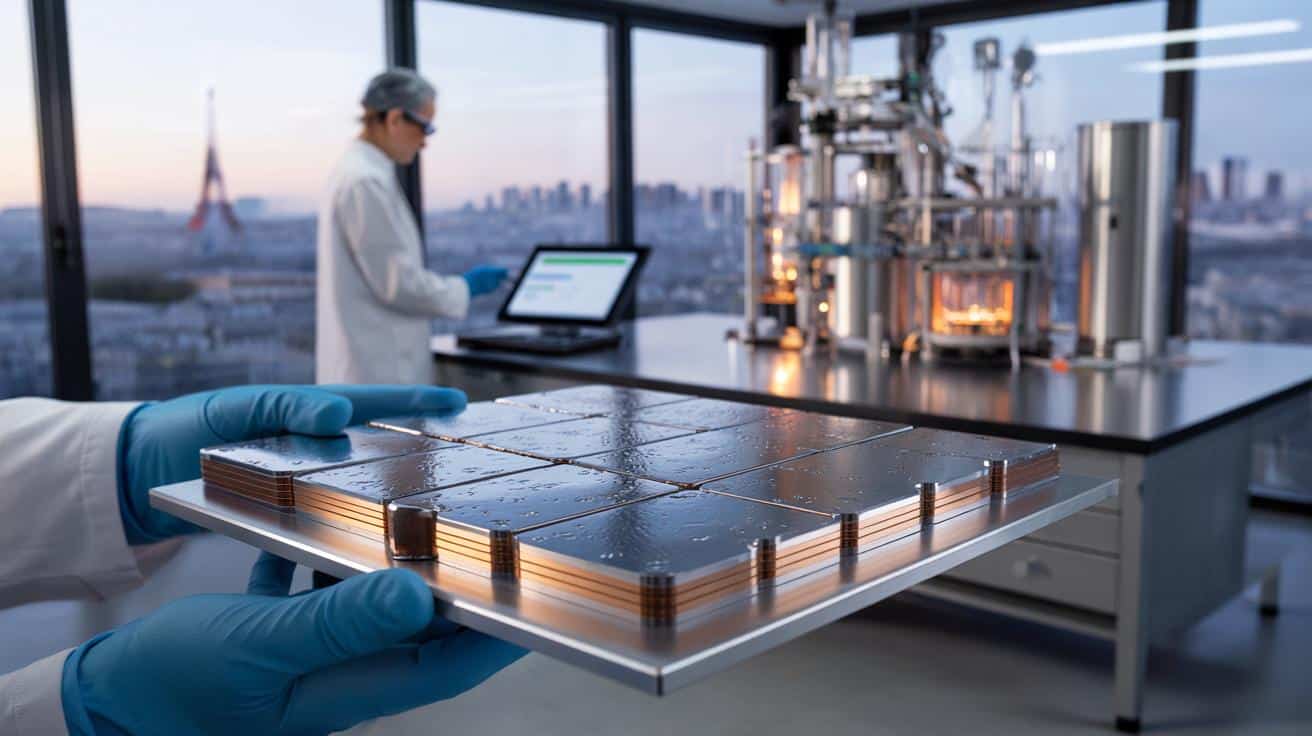
After years of trailing China, South Korea and the US, France is starting to claw its way back into the advanced battery race, thanks to a public‑private push on solid‑state technology and a landmark study that finally tells industrial leaders what is physically achievable.
France moves from bystander to contender in the battery boom
The timing could hardly matter more. The global lithium‑ion battery market is forecast to exceed €129 billion in 2026 and could approach €480 billion by 2035, driven mainly by electric vehicles but also by grid storage, aviation projects and defence applications.
France, despite a strong automotive legacy and powerful energy champions, spent much of the past decade lagging in cell research and manufacturing capacity. Asian giants built giga‑factories. US players rode the EV wave. French industry, for a while, mostly watched.
That phase is ending. New industrial programmes, targeted state support and tighter links between public research and factories are beginning to shift the balance. A central focus is solid‑state batteries, seen by many as the next leap after today’s lithium‑ion cells.
France is now betting that mastering ultra‑thin lithium metal electrodes can unlock safe, high‑density solid‑state batteries at scale.
Since 2022, a joint project has brought together the CEA (France’s public research powerhouse), Saft (a TotalEnergies subsidiary) and Automotive Cells Company (ACC, backed by Stellantis and Mercedes). Their shared objective is ambitious: produce ultra‑thin lithium metal negative electrodes, manufactured cleanly and repeatably enough for real factories rather than niche lab experiments.
Why solid-state batteries are such a big deal
Conventional lithium‑ion batteries rely on a liquid electrolyte. That liquid lets lithium ions move between the positive and negative electrodes, but it comes with trade‑offs: it is flammable, sensitive to impacts, and requires heavy safety and control systems. All of that limits charging speed, energy density and safety margins.
Solid‑state cells replace the liquid with a solid electrolyte, a sort of rigid membrane that lets ions pass but cannot leak or burn. That opens three doors at once: more energy in the same volume, better thermal stability, and the realistic option to use lithium metal as the negative electrode.
Lithium metal is attractive because it stores far more energy per kilogram than the graphite or silicon‑graphite mixes used today. Paired with a solid electrolyte, it promises longer range for EVs, faster charging, and lighter packs for aircraft and satellites.
➡️ “I make it in 10 minutes for the whole family”: my ultra-easy leek, apple and bacon skillet
➡️ Heating off at night: money-saving trick or costly mistake?
➡️ Dieser alte Lorbeer-Trick ist zurück: Warum man ihn laut Fachleuten an die Tür hängen sollte
The ultra-thin challenge
There is a catch. To unlock the full benefit, industry needs lithium metal layers thinner than 20 micrometres, uniform and dense, reproduced millions of times with industrial consistency. Traditional rolling or calendering methods struggle badly in this thickness range.
This is where the new French work matters. Researchers aimed not just at another “record” but at understanding how thin lithium can go, what fails first, and where the useful industrial window lies.
The core finding: there is a sweet spot for lithium thickness, and going thicker does not always give longer life — it can even make things worse.
A new way to make lithium metal films
From heavy metallurgy to micro‑fabrication logic
Instead of flattening lithium blocks into foils, CEA teams turned to evaporation, a technique more familiar to chip makers than to rolling mills. Lithium is vaporised in a vacuum, then condensed as a continuous film on a substrate, usually a thin copper foil.
At CEA Tech Nouvelle‑Aquitaine, this route produced highly dense layers with low roughness and controlled surface contamination. Thanks to high‑resolution microscopy on the Nanocaracterisation Platform, scientists saw compact lithium with well‑defined grains and a surface nearly as smooth as the copper underneath.
This calm, flat surface is not a matter of aesthetics. It reduces side reactions between lithium and the electrolyte, which otherwise eat away at the electrode and shorten battery life.
Three behavioural regimes for lithium thickness
The study went a step further by systematically testing lithium foils from 2 to 135 micrometres in a liquid electrolyte. The goal was not to beat records, but to map failure modes.
- Below about 20 micrometres, the amount of active lithium is simply too low. Cells work at first, then performance drops quickly as the lithium is consumed.
- Above roughly 50 micrometres, a different issue appears. Interfacial resistance at the lithium–electrolyte boundary rises, lithium is lost irreversibly in side reactions, and adding more thickness brings no extra lifetime.
- Between 20 and 50 micrometres lies a transition zone in which structure, interface chemistry and operating conditions become decisive.
Researchers liken the electrode to a landscape exposed to erosion. If it is too thin, it vanishes quickly. If it is too thick, dead layers accumulate and block transport. Somewhere in between lies the workable compromise for industrial design.
What this means for French industry
From lab insight to factory decisions
The industrial message is clear: ultra‑thin lithium metal is feasible with evaporation, but thickness must be carefully chosen. Beyond a certain point, more lithium means more waste and no gain.
For players like Saft and ACC, this shapes investment choices: which deposition tools to back, what quality controls to install, how much lithium to source, and how to size future solid‑state lines in cost and carbon terms.
Thinner electrodes cut raw material consumption, lighten packs for the same energy, and can reduce certain safety risks by limiting runaway reactions. They also demand tighter process control and better interface engineering, which favours countries that already have strong research‑fabrication ecosystems.
The study acts as a design guide: it sets physical boundaries that help French “captains of industry” avoid dead ends as they scale up.
A dense ecosystem forming around solid-state tech
The research does not stand alone. A group of French or France‑based consortia is racing to secure every part of the future solid‑state supply chain, from electrolytes to complete cells.
| Group / consortium | Project status (2026) | Target technologies | Key partners |
| Argylium (Axens + Syensqo) | Pilot line in La Rochelle; tonne‑scale output aimed for 2027‑28 | Sulphide solid electrolytes (argyrodites), with targets around 500 Wh/kg and sub‑10‑minute charging | IFPEN, European carmakers |
| ACC (Stellantis, Saft, Mercedes) | Pilot lines running; solid‑state roadmap into the late 2020s | Polymer and sulphide solid electrolytes | Factorial (US), Solvay |
| Stellantis | Solid‑state demonstrators validated for 2026 | Lithium‑metal anodes with solid electrolytes | Factorial Energy (US) |
| Prologium France | Solid‑state gigafactory under construction in Dunkirk | Ceramic solid‑state lithium‑metal cells targeting 700+ Wh/kg | Renault, French state |
| Torow | ASSB25 pilot project for 2027 | All‑solid sodium cells without lithium, cobalt or nickel | Pôle DERBI‑CEMATER |
| E‑lyt Labs | Pilot line expected in operation in 2026 | High‑performance sulphide solid electrolytes with up to triple the volumetric energy of current lithium‑ion | Automotive investors |
In this landscape, companies such as Argylium stand out. Based near Paris, it is targeting European leadership in sulphide solid electrolytes, a critical material without which many solid‑state concepts remain stuck as lab prototypes.
Beyond cars: where ultra-thin lithium could land next
Electric cars grab the headlines, but they are not the only sector watching French progress.
Aviation, defence and grid storage
In aerospace, every kilogram saved has financial and safety consequences. High‑density solid‑state packs with well‑controlled lithium could enable hybrid aircraft, long‑endurance drones or satellites with more payload and less battery mass.
Defence systems place reliability and stability above all. Solid electrolytes remove liquid leakage risks and reduce fire hazards, while thin lithium layers help keep cells compact and robust. For submarines, missiles or remote sensing platforms, that combination is attractive.
On the grid, where batteries smooth renewable power and stabilise networks, safety and long life trump range or fast charging. Here, the French findings on degradation regimes and interfacial resistance can help operators weight cycle life against cost and energy density more rationally.
Key notions readers keep asking about
What “solid-state” really changes day to day
For a driver, a mature solid‑state battery could mean an EV that charges in under 10 minutes and still delivers long range, with a pack that lasts longer before noticeable capacity fade. For a grid operator, it could mean storage blocks that take up less space in dense cities and carry lower fire‑safety costs.
That said, not all solid‑state batteries will look the same. Some may prioritise safety with moderate energy density gains; others may push for record‑breaking numbers but need tighter operating windows. Policy makers and buyers will have to read between the lines of marketing claims.
Risks and trade-offs on the road ahead
France’s renewed push comes with real risks. Scaling evaporation processes for lithium to gigafactory volumes is non‑trivial. Any defect in thickness, roughness or surface chemistry multiplies across millions of cells. This demands heavy investment in equipment, metrology and recycling.
The raw‑materials angle also matters. Even if lithium consumption per cell drops thanks to thinner electrodes, total demand will soar with the size of the market. That raises geopolitical questions, from mining practices to dependence on foreign suppliers. One reason France and Europe are also betting on sodium solid‑state projects, such as Torow’s, is precisely to hedge against lithium constraints.
There is also an industrial culture shift. Traditional carmakers and energy groups must work at micrometre scales, borrowing tools and mindsets from semiconductor fabrication. France’s research ecosystem, with institutions like the CEA, gives it a chance to bridge that gap — if industry leaders move quickly enough.