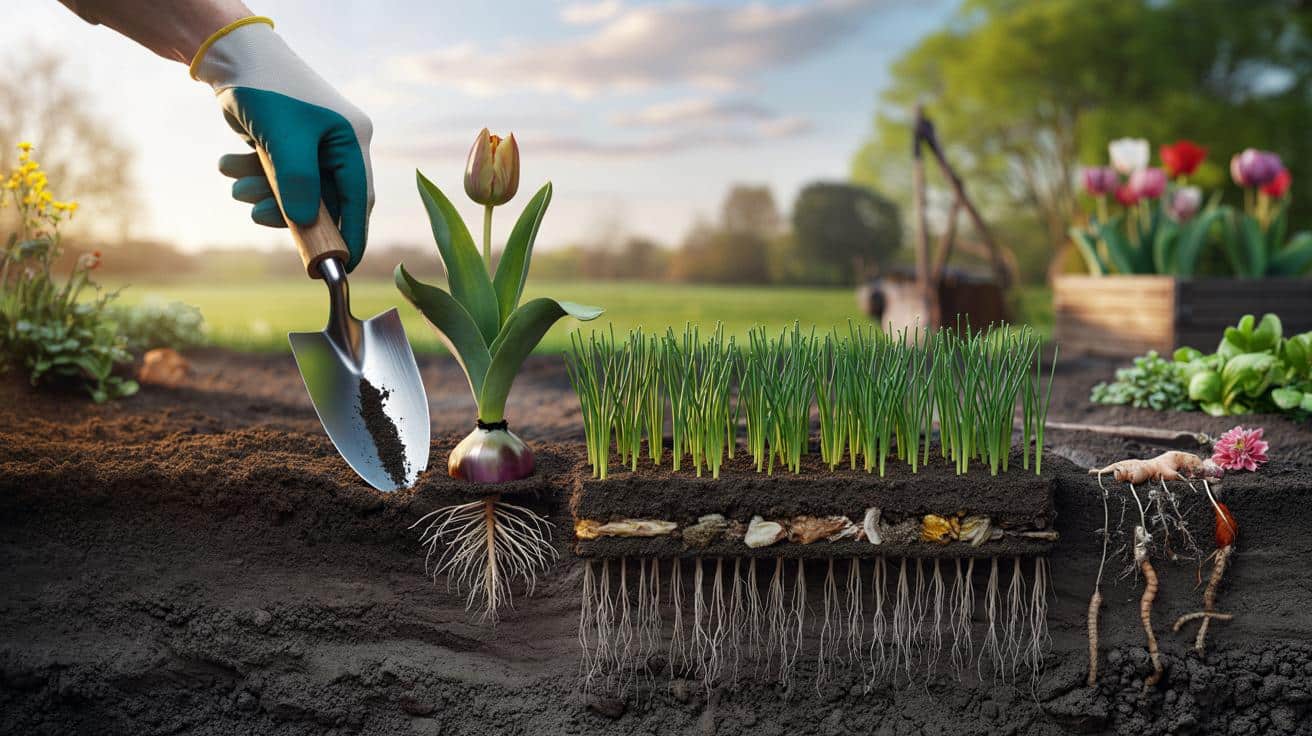
Across Europe and North America, more gardeners are whispering about a “magic depth” of just seven centimetres. Others shrug it off as a fad. Yet trials, soil science and field experience all keep pointing to the same figure: 7 cm can radically shift how plants root, feed and resist stress, especially in late autumn and early spring.
The 7 cm rule that unsettles traditional gardeners
Most of us were taught to judge planting depth by eye: “about a finger,” “twice the height of the bulb,” or “a bit deeper if the winter is harsh.” Tape measures rarely enter the shed. That is precisely why the 7 cm rule annoys so many experienced gardeners: it sounds too precise, almost dogmatic.
Seven centimetres is not a magic spell, but it is a repeatable sweet spot that soil scientists keep seeing in trials.
At roughly 7 cm below the soil surface, many common garden plants hit a narrow band where roots breathe easily, moisture stays steadier, and temperature swings are less brutal. For vegetable beds, perennial borders and bulbs, this band often separates plants that merely survive from those that actually bulk up.
Why 7 cm feels counter‑intuitive
Older gardening habits were shaped before modern tools and studies. People worked by instinct and imitation. Deep planting was seen as a kind of insurance policy: bury it well and the frost can’t touch it. Light covering was dismissed as careless.
Today, test plots run by horticultural institutes tell a different story. Planting too deep suffocates young roots, especially in heavy or compacted soils. Planting too shallow leaves them at the mercy of wind, sun and sudden cold snaps. The “rule of seven” emerged not from fashion, but from repeatedly measuring where roots perform best in real conditions.
On loamy soils in temperate climates, seven centimetres is often where protection and oxygen finally shake hands.
What actually happens 7 cm under your boots
To understand why 7 cm keeps coming up, you have to think less about leaves and more about the world just under the trowel blade. That thin layer hides a surprisingly busy ecosystem.
The delicate balance of air, water and temperature
The first few centimetres of soil are extremely reactive. They heat up fast, cool fast and dry out in a matter of hours under summer sun. Just below that, around 7 cm, conditions calm down.
➡️ Veterinäre geben wichtige Warnung an alle Katzenbesitzer heraus
➡️ The ancients always prepared their soil this way in February: their harvests were twice as abundant
- Air: Pores remain open enough for roots to get oxygen.
- Water: Moisture lingers longer than on the surface but doesn’t usually stagnate.
- Temperature: Daily extremes are softened, which limits stress on young root tips.
This combination means seedlings and newly planted bulbs can develop fine feeder roots without constantly stopping and starting. The plant spends less energy on emergency responses and more on steady growth.
Life in the root zone
Seven centimetres also sits right inside the zone where earthworms routinely travel, where fungi connect roots into underground networks, and where bacteria break down organic matter into forms plants can absorb.
The 7 cm band is where roots meet the highest traffic of worms, fungi and bacteria that feed and protect them.
When roots are placed too far below this layer, they take longer to reach that busy strip of life. Too close to the surface, they dry out or freeze before they can build a proper system. At around 7 cm, roots are close enough to organic debris and soil life, but still shielded from surface shocks.
Common planting mistakes: too deep, too shallow
The pushback against the 7 cm rule often comes from gardeners who feel they already “know what works.” Yet, when problems appear later in the season, the cause is rarely traced back to planting depth.
What goes wrong when you bury plants
A seedling pushed too far down into the soil faces several risks. On clay or compacted ground, the deeper layers are poorly aerated. Roots need oxygen; without it, they slow their growth or rot. Excess depth also means cooler soil in spring, delaying germination and early growth.
Over‑buried bulbs respond by forming weak, elongated shoots that take longer to reach the light. That delay can expose them to late frosts or fungal infections in cold, damp soils. The result is fewer, smaller flowers.
The danger of “just under the surface”
Planting too close to the surface can be just as damaging. A shallow‑set root ball dries out quickly between waterings, especially in windy or south‑facing spots. With minimal soil above them, roots get almost no insulation from frosty nights.
Too shallow means constant stress: freeze, thaw, dry, scorch. Roots never settle, and the plant limps through the season.
Gardeners often respond with more watering, more fertiliser and more mulching, trying to “fix” problems that actually began the day the trowel went in at the wrong depth.
Putting the 7 cm rule to work in real beds
The 7 cm idea is not a rigid law, but a practical reference point. It becomes especially useful in late autumn, when you are tucking the garden in for winter and planning a strong start for spring.
Typical uses of the 7 cm depth
| Plant type | How 7 cm applies |
|---|---|
| Root vegetables (carrots, parsnips, turnips) | Seed line placed about 7 cm below finished surface in light to medium soils. |
| Young transplants (salads, brassicas, annual flowers) | The collar sits so that about 7 cm of soil cover the upper roots. |
| Spring bulbs (tulips, daffodils, ornamental alliums) | Base of the bulb positioned roughly 7 cm below the surface in mild climates. |
| Mulched beds | Combined soil and mulch cover keeps the key root zone close to the 7 cm band. |
On very sandy soil, you may go slightly deeper to hold moisture. On very heavy clay, you may raise beds and still aim to keep the active roots near that 7 cm layer, but with better drainage.
Simple tricks to actually hit 7 cm
Few people walk around the garden with a ruler in hand. Still, some low‑tech habits make accurate planting much easier.
- Mark 7 cm on your favourite trowel using permanent marker or a scratch line.
- Keep a short wooden stick with centimetre marks in your pocket during planting sessions.
- When mulching, think in totals: 4 cm of soil above seed plus 3 cm of mulch equals that 7 cm protection zone.
Once your eye is trained, 7 cm stops being a number and becomes a familiar “feel” in your hand.
Visible effects on crops and borders
Gardeners who adopt a more precise depth often notice changes within a single season. Germination lines become more even. Whole rows of seedlings appear together rather than in patchy clumps. Bulb displays come up more synchronised, which makes beds look fuller.
Better rooting, cleaner foliage
Stronger root systems at the right depth have knock‑on benefits above ground. Plants cope better with short dry spells, which means less emergency watering. Stable soil moisture at 7 cm also narrows the window for fungal diseases linked to splash and stress.
In tests with salad crops, beds planted near that ideal depth showed fewer cases of damping‑off and faster recovery after transplant shock. Borders planted with perennials at more controlled depths bulked up earlier in spring and needed less staking by midsummer.
Long‑term gains for soil health
Consistent use of a realistic depth also shapes how soil develops. Roots repeatedly working the same zone create a looser, crumbly structure. Organic mulches laid to protect that band slowly feed it with humus.
Year after year, a stable 7 cm root zone turns into a living sponge: better drainage, better moisture retention, better life.
That living sponge cuts down on erosion during heavy rain and reduces crusting during hot spells. Earthworm numbers rise, further improving structure and nutrient cycling. Over time, you spend less effort correcting problems and more time fine‑tuning plant choices.
When 7 cm is a guide, not a rule
Not every plant wants the same treatment. Trees, shrubs and some large bulbs have their own requirements. The 7 cm principle still helps, but as a reference for the most active roots, not for the whole plant.
For roses and woody shrubs, the main objective is to keep the graft union just above the soil line in most climates, while allowing a web of feeder roots to work around the upper 10 cm. Here, adjusting soil level and mulch depth around that band is more relevant than respecting a single number.
In very cold or very hot regions, gardeners may also shift slightly from the 7 cm figure. The key idea remains the same: roots should live in a layer where water, air and temperature are reasonably balanced. Seven centimetres is simply where that balance often appears first in temperate gardens with average soils.
Extra tips: from theory to your own patch
One useful exercise is to run a mini “simulation” in your own garden. Pick two short rows of the same crop next season. Plant one at “usual” depth, and the other as close as you can to 7 cm, marking it carefully. Keep all other care identical. Watch which line emerges first, which wilts less, and which resists a dry spell or cold snap better.
Another angle is to combine depth with companion planting and mulching. A bed where roots sit in that stable zone, shaded by taller companions and protected by light organic mulch, often needs fewer inputs. You save water, cut back on fertiliser, and still get respectable yields. The effect is cumulative: better depth, better cover, better soil life.
For new gardeners, this small focus on depth can also give confidence. Gardening often feels vague and full of conflicting opinions. Working with a concrete measurement such as 7 cm turns part of the process into something you can test, adjust and truly understand on your own ground.