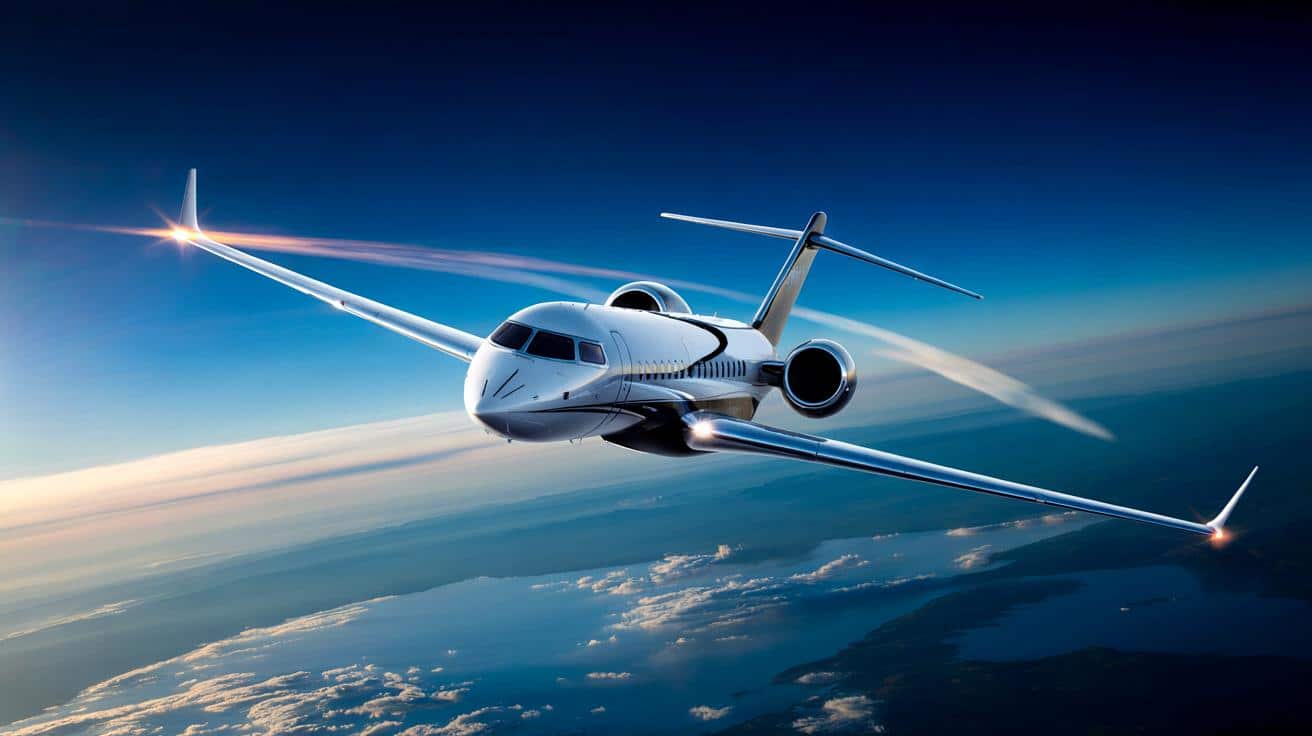
While supersonic dreams have mostly faded since Concorde, one manufacturer has found a way to squeeze more speed out of conventional air travel, and get official approval to sell it to the ultra-wealthy.
A near-supersonic record that actually matters
Canadian manufacturer Bombardier has secured European certification for its Global 8000, a long-range business jet that now holds a striking title: the fastest civil aircraft in service since Concorde.
The Bombardier Global 8000 reaches a certified maximum speed of Mach 0.95, pushing right up against the transonic limit while remaining commercially viable.
Mach 0.95 means the jet flies at 95% of the speed of sound, or around 1,155 km/h (718 mph) at cruise altitude. Reaching that region is far from simple. As aircraft approach Mach 1, they enter what engineers call the transonic regime. Local pockets of airflow over the wings and fuselage can go supersonic, generating shock waves that spike drag and disturb lift.
In practice, that means you need a lot more thrust and a very carefully shaped airframe just to gain a few extra knots. Most airliners settle for cruise speeds around Mach 0.82–0.85 in order to keep fuel burn, noise and structural stress under control.
Bombardier’s idea with the Global 8000 is not to smash through the sound barrier, but to “flirt” with it. The aircraft sits just below the point where regulations, physics and operating costs start fighting back too hard.
From crisis to comeback: Bombardier doubles down on business jets
Who Bombardier is and how it got here
Bombardier’s aviation arm grew out of the acquisition of Canadair in the 1980s, building on a legacy that began with military and then regional aircraft. By the early 2000s, the company had become the world’s fourth-largest commercial aircraft manufacturer, with products ranging from turboprop Dash 8s to CRJ regional jets and high-end Challenger and Global business jets.
That trajectory hit serious turbulence. After the 9/11 attacks, demand plunged. A bruising trade fight over the CSeries airliner and spiralling programme costs pushed Bombardier to the edge. The CSeries itself eventually moved under Airbus control and re-emerged as the A220. Between 2018 and 2020, Bombardier sold off its commercial aviation activities, including the CRJ and turboprops, and walked away from amphibious aircraft.
The company that once tried to compete head-on with Boeing and Airbus now focuses almost entirely on high-end private jets.
➡️ Was bedeutet es laut Psychologie, wenn jemand andere ständig unterbricht?
➡️ Heating off at night: money-saving trick or costly mistake?
➡️ This simple winter habit promises hydrangeas smothered in blooms this spring
That strategic retreat has freed Bombardier to pour engineering effort into a narrower but lucrative niche: long-range, fast business aircraft used by corporations, governments and billionaires. The Global 8000 is the flagship of this new, leaner Bombardier.
Triple certification: not just a showpiece
Why EASA approval is a big deal
The Global 8000 first gained certification in Canada in November 2025, followed by approval from the US Federal Aviation Administration (FAA) in December the same year. The final step was the European Union Aviation Safety Agency (EASA), known for some of the toughest safety standards on the planet.
EASA certification validates the aircraft’s structure, systems, flight performance and safety margins under a dense web of regulations. It is far from a rubber stamp. Clearing that hurdle means the jet can be operated commercially across the EU, and signals to other regulators worldwide that the design is mature.
With Canadian, US and European approvals in hand, the Global 8000 is no longer a technology demonstrator; it is a revenue-ready aircraft that can fly almost anywhere operators need it.
Range, speed and cabin: what the Global 8000 actually offers
14,800 km non-stop: city pairs that used to need a fuel stop
The headline range of the Global 8000 is 8,000 nautical miles, or about 14,800 kilometres. That places it firmly in the ultra-long-range category.
- Paris–Singapore: about 10,800 km, non-stop within its comfort zone
- Los Angeles–Sydney: roughly 12,000 km, easily within range
- London–Buenos Aires or New York–Johannesburg: also reachable without refuelling
Inside, Bombardier has split the cabin into four genuine zones. One can be configured as an office, another as a dining or meeting area, plus a lounge space and a private bedroom. The idea is that passengers can move through a work–rest–sleep cycle during flights that may run to fifteen hours or longer.
Smooth Flex Wing: two wings in one
The wing is central to the Global 8000’s performance story. Bombardier’s Smooth Flex Wing technology aims to reconcile two opposing needs: lift and stability at low speed, and clean aerodynamics at very high speed.
At lower speeds, such as during take-off and landing, the wing geometry and control surfaces maximise lift and handling. At high cruise near Mach 0.95, the wing’s shape and flexibility reduce transonic drag and delay the onset of shock waves.
This wing concept allows the Global 8000 to operate from shorter runways like a smaller jet, while still cruising faster than any other civil aircraft currently in production.
That combination matters because many business travellers want to use secondary airports closer to city centres. Bombardier claims the Global 8000 can access around 30% more airports than a typical large jet of similar weight.
Digital cockpit for very long days
Up front, the Vision Flight Deck uses a fully digital fly-by-wire architecture. Pilot inputs are interpreted by computers, which then command the control surfaces. This allows fine-tuned stability and workload management, especially at the edges of the speed envelope.
Extensive simulator and flight testing with crews fed into the final layout. The goal was to reduce mental fatigue and improve situational awareness on missions that can stretch across multiple time zones.
Cabin air as a selling point
On a long-haul flight, passengers usually think about seat pitch and catering. Bombardier has instead emphasised air quality as a technical feature. The Global 8000 uses its Pũr Air system, combining hospital-grade HEPA filtration—removing 99.99% of particulates—with an active charcoal filter to reduce odours and volatile organic compounds.
Cabin air is refreshed more frequently than on a typical airline aircraft. For passengers, that can translate into less dryness, fewer headaches and better alertness after landing, which matters when you step off the jet straight into negotiations.
Two aircraft in one: the business case for near-Mach travel
Speed as a tool, not a stunt
Bombardier pitches the Global 8000 as “two aircraft in one”: the range and comfort of a top-tier long-haul jet, paired with speeds that nibble at the sound barrier. For the target buyers—multinationals, heads of state, ultra-high-net-worth individuals—time is a quantifiable asset.
Saving an hour or two on a transcontinental journey can mean an extra meeting, a better rest window, or a tighter same-day turnaround.
By flying faster and using smaller airports, the aircraft aims to shorten door-to-door travel time, not just the airborne portion. That end-to-end time saving is what many operators will weigh against the aircraft’s roughly €74 million price tag.
Living in Concorde’s shadow: a different path to speed
Why Bombardier stopped short of supersonic
Unlike Concorde, which routinely cruised above Mach 2, the Global 8000 stays on the subsonic side of the line. There are several practical reasons: supersonic flight brings sharp increases in fuel burn, higher maintenance demands, sonic boom restrictions and more complex certification requirements.
By topping out at Mach 0.95, Bombardier can leverage existing infrastructure and fuel standards, avoid boom-related flight path restrictions, and keep its aircraft attractive to operators who value predictability of costs.
This strategy also gives Bombardier a hedge against environmental regulation. Long-range jets already sit under scrutiny for their emissions. A full supersonic programme would face an even tougher political and regulatory climate, especially in Europe.
Rivals in the ultra long-range jet market
A crowded field of very fast, very expensive jets
The Global 8000 is not alone in chasing ultra-wealthy customers. It faces stiff competition from Gulfstream and Dassault, which are pushing their own blends of speed, range and comfort.
| Aircraft | Range (km) | Top speed (Mach / km/h) | Cabin (m² / zones) | Price (M€) |
| Global 8000 | 14,816 | 0.95 / 1,155 | 16.6 / 4 | 74 |
| Gulfstream G700 | 13,890 | 0.935 / 1,135 | 17.1 / 4 | 72 |
| Falcon 10X | 13,890 | 0.925 / 1,125 | 16.1 / 4 | 69 |
| Gulfstream G800 | 14,816 | 0.925 / 1,125 | 17.5 / 4 | 74 |
| Global 7500 | 14,264 | 0.925 / 1,125 | 16.6 / 4 | 67 |
Gulfstream’s G700 and G800 focus on cabin width and luxury, while Dassault’s Falcon 10X leans on fuel efficiency and European industrial backing. All target similar mission profiles: linking financial centres non-stop and accessing secondary airports.
Key concepts: Mach number, transonic flight and cabin altitude
What Mach 0.95 really means for passengers
Mach is the ratio between an object’s speed and the speed of sound in the surrounding air. At cruise altitude, where the air is colder and thinner, the speed of sound is lower than at sea level. Mach 0.95 at 40,000 feet is not the same ground speed as Mach 0.95 near the ground, but for travellers the key point is time.
Compared with a conventional airliner flying at Mach 0.84, a jet at Mach 0.95 can shave roughly 45–60 minutes off an 11–12 hour flight, depending on winds and routing. Over a year of frequent long-haul travel, that adds up to days of regained time.
Aircraft like the Global 8000 also maintain a lower “cabin altitude”, meaning the pressurised interior mimics a lower altitude than many airlines do. That reduces fatigue and dehydration. Combined with fresh air systems and quiet cabins, the overall physiological load on passengers can be significantly lower than in standard business class.
Scenario: how an operator might use this speed
Consider a company based in London with major operations in Singapore and Los Angeles. With an aircraft like the Global 8000, executives could fly London–Singapore overnight at near-Mach speeds, hold a full day of meetings, then continue to Sydney without stopping for fuel. On the return leg, they might route via a smaller airport closer to a project site rather than a major hub.
For a government operator, the same platform could be used for long-range diplomatic missions or rapid deployment of small teams, arriving close to final destinations that larger airliners cannot easily reach.
The trade-offs are substantial fuel consumption and a heavy climate footprint, balanced against the operational flexibility and time savings that these aircraft provide to a very small number of users. As regulators and investors increase pressure on aviation emissions, jets at the edge of the performance envelope such as the Global 8000 will sit at the centre of that debate.