That’s when the romance of crackling flames collides with aching backs, damp garages and messy piles of sacks. A new generation of pellet storage solutions is quietly changing that picture, promising a cleaner living room and far fewer trips to the cellar.
Why smart pellet storage changes winter evenings
Pellet stoves have surged across Europe and North America as gas and electricity prices climb. They offer efficient heating, relatively low emissions and a cosy focal point in the room. Yet one very practical issue often spoils the experience: where to keep the fuel.
Standard 15 kg bags end up stacked in corridors, garages or sheds. Every evening, someone trudges out in the cold, hauls a bag indoors and wrestles it open next to the stove. Pellets spill, plastic crinkles, and dust settles on the floor.
Centralised, well-sealed storage close to the stove turns pellet heating from a chore into an almost automatic gesture.
Access beats exercise in front of the fire
With a dedicated container sitting next to or near the appliance, bags can be emptied in one go during the day, rather than dragged in at night. That means:
- fewer trips to the basement or garage
- less mess from cutting open bags in the living space
- a small stock always ready to hand when the fire needs topping up
The shift sounds minor, but over a long winter it changes the routine. Instead of interrupting a film or dinner to go for more pellets, you simply open a lid or a hatch and pour.
Pellets hate damp even more than you do
Pellet fuel looks tough but behaves like a sponge. Stored too close to a damp wall or on a bare concrete floor, it absorbs moisture, swells and starts to crumble. Once damaged, pellets burn poorly, can clog augers and generate more ash.
A sealed, rigid container creates a controlled micro-environment. Pellets stay dry, protected from accidental splashes, condensation and everyday knocks. That also reduces the temptation to store open bags on the balcony or near an outside door, where weather can quickly ruin them.
When storage becomes part of the decor
Early pellet bins were often purely utilitarian: plastic crates or metal chests that looked at home in a workshop. The latest generation takes a very different approach. Manufacturers now treat pellet storage as a piece of furniture in its own right.
➡️ China ‘revives’ a 50-year-old technology that uses 200 times less energy than digital computing
➡️ Salz im Spülmittel: ein genialer Trick, der Ihr größtes Küchenproblem löst
➡️ «Ich spare 30 Minuten pro Woche»: Diese Methode zum Fensterputzen geht ultraschnell
➡️ Kein Pulli, keine Feuchttücher: der neue Trick, der Brillengläser wieder wie neu macht
Design-led pellet chests aim to hide the fuel in plain sight, blending in with sideboards, coffee tables and bookcases.
Materials that don’t scream “utility room”
Instead of raw plastic, brands are betting on powder-coated steel, wood veneer or mixed materials. Neutral tones, matte finishes and clean lines help these containers sit comfortably in a Scandinavian, industrial or more classic interior.
For many users, this is a real advantage. Rather than staring at stacked sacks with large logos and bright colours, you see a discreet piece of furniture that happens to hold 40 to 50 kg of fuel.
Functionality that shaves minutes off each refill
Beyond aesthetics, these products are engineered for everyday use. Common features include:
- a hinged lid that opens fully for easy bag emptying
- a front hatch or chute that lets you fill a small scoop without bending over
- wheels hidden under the base so the chest can be moved for cleaning
- ergonomic handles for occasional repositioning
The result is simple: less lifting, less twisting and less vacuuming up stray pellets.
How to choose the right pellet storage for your home
The market now offers a wide range of options, from compact cubes to tall cabinets. A few criteria help narrow the choice.
| Criterion | What to look for |
|---|---|
| Capacity | At least 40–50 kg, enough for several days of heating in winter. |
| Material | Steel with anti-corrosion treatment or reinforced plastic, both resistant to damp and knocks. |
| Ease of use | Lid, hatch, handles, wheels and a form that lets you pour comfortably. |
| Design | A colour and style that match the stove and furniture already in the room. |
Capacity is often underestimated. Many households go through more than one 15 kg bag per day during a cold spell. A chest that holds around 45 kg avoids constant topping up from the main stock, yet remains compact enough for a living room corner.
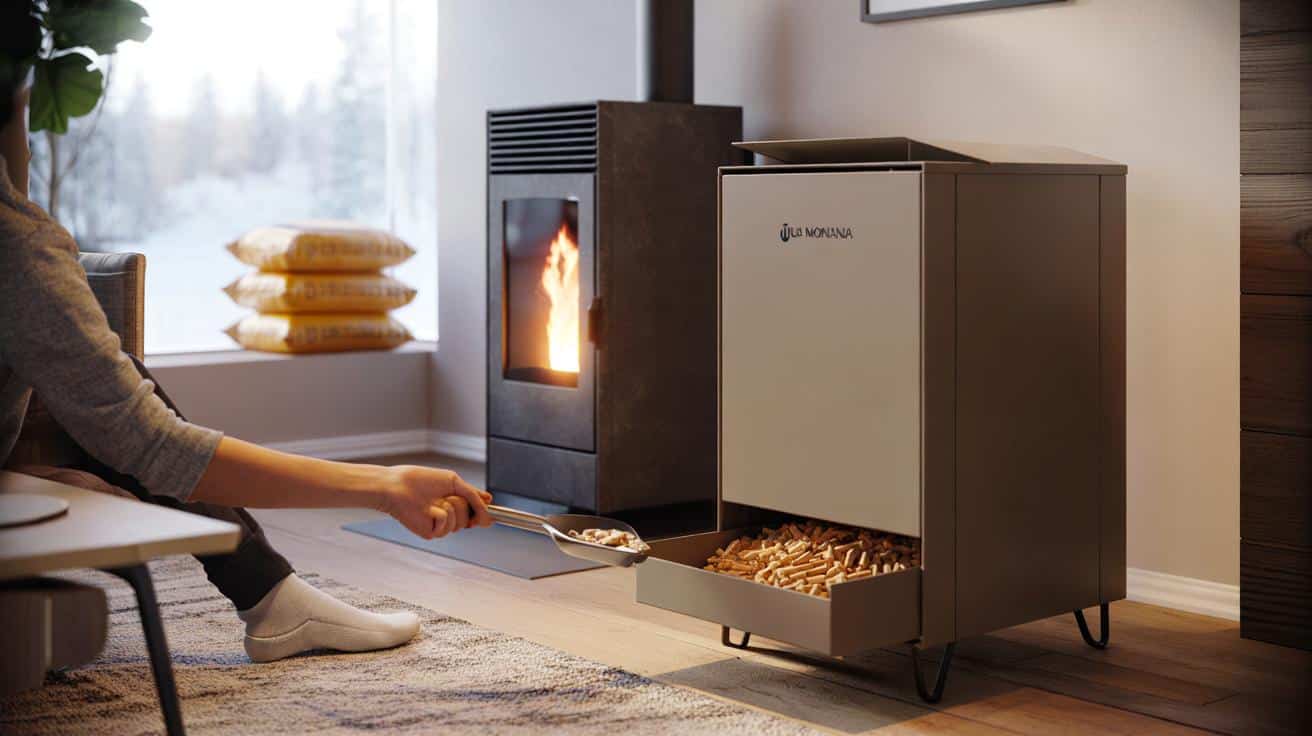
Inside the XL “Jura Montania” pellet chest
Among the models attracting attention in French and central European markets is the XL “Jura Montania” pellet chest. Designed as a large-capacity companion for mid-range and high-end stoves, it aims to merge furniture-grade design with serious storage volume.
With a capacity of up to 45 kg, the XL chest can hold three standard bags of pellets in one go.
Storage volume that matches real usage
The 45 kg figure is not arbitrary. In practice, that amount often covers two to three days of heating for an average, well-insulated home, sometimes more in milder regions. That means one loading operation, then several days of effortless refills via the hatch.
For people who work long hours or have mobility issues, that autonomy makes a noticeable difference. The evening no longer starts with dragging a bag in from the shed.
Robust build, discreet presence
The Jura Montania chest relies on high-grade steel for its structure. This rigid shell resists minor impacts from tools, toys or vacuum cleaners, and shields the pellets from nearby radiators or damp air pockets.
The shape stays deliberately simple: straight lines, a flat lid, and a minimalist handle. The finish leans towards contemporary interiors, with colours that complement popular black or dark grey pellet stoves.
A built-in distribution hatch lets you pour pellets directly into a small scoop or jug, keeping contact with the fuel to a minimum. That cuts down on dust in the air and reduces the risk of spilling pellets into the stove’s mechanism.
Why this kind of purchase pays off over time
A design-focused pellet chest might look like a lifestyle upgrade, but it also plays a technical and financial role.
- Less wastage: sealed storage reduces the number of bags damaged by moisture or punctures.
- More stable combustion: dry, intact pellets burn more evenly, which can improve stove performance.
- Cleaner space: fewer open bags lying around means less dust and plastic clutter.
A well-sealed chest extends the usable life of each pellet bag, avoiding the hidden cost of wasted fuel.
When pellets take on moisture, their energy content per kilogram falls. You burn more to reach the same level of comfort, and you empty the ash pan more often. Over several winters, that extra consumption can quietly outweigh the cost of a proper storage unit.
Practical scenarios: what changes in a typical winter
Consider a household that uses two bags per day on average from December to February. Without a chest, that means handling around 180 bags over three months, often late in the evening, and often in bad weather.
With a 45 kg storage unit, the routine shifts. Every two days, three bags are brought in during daylight and emptied in one go. Indoors, topping up the stove becomes a quick movement repeated a few times a day, not a mini weightlifting session. The garage stays as the bulk storage area, while the living room holds just what is needed.
For older users or people with back problems, that difference in handling can reduce strain and lower the risk of small daily injuries that tend to accumulate over winter.
Key notions for new pellet users
Two concepts often come up when choosing storage: humidity resistance and ergonomics.
Humidity resistance is not only about rain. In many houses, cold walls, unheated rooms and concrete floors all promote condensation. A chest raised slightly off the floor and made of treated steel or quality plastic breaks that contact and blocks moisture migration.
Ergonomics simply means fitting the object to the body, not the other way round. A lid that opens towards you rather than against a wall, a hatch at waist height, wheels that roll even on a rug: these details turn an occasional hassle into a routine you barely notice.
Combined thoughtfully, design and practicality give pellet stoves what they were missing in many homes: a storage solution that respects both the fuel and the people using it.